

TENNIS ELBOW TREATMENT IN WAYNE, NJ | TRINITY REHAB
Few towns in North Jersey take racquet sports as seriously as Wayne. The Municipal Complex offers twelve lighted tennis courts and two platform tennis courts, drawing players out for evening matches well past sundown. Add the Wayne Racquet Club, Packanack Lake Tennis Club, and Wayne Indoor Tennis Club, and you have a community where competitive doubles leagues, round-robins, and post-work hitting sessions are part of daily life. Sportime Pickleball and LA Fitness racquetball courts round out a town that never stops swinging.
Now picture this: you spend your workday at BAE Systems running precision assembly, or managing distribution logistics at Driscoll Foods, gripping hand tools for eight hours straight. By 6 p.m. you’re at the Wayne Racquet Club for Thursday doubles. The first few serves feel fine. Then, on a hard backhand return, a sharp pull radiates from the outside of your elbow through your forearm. The next morning, you can barely grip your coffee mug.
That scenario plays out weekly across Wayne — in the lake communities of Packanack Lake and Pines Lake, near Laurelwood Arboretum, and in neighborhoods tucked against High Mountain Park Reserve. Wayne is an affluent suburb of roughly 55,000 people, and its residents push hard at work and on the court. When elbow pain disrupts that rhythm, Trinity Rehab Wayne provides the specialized physical therapy to get you back in play.
Whether you’re visiting the historic Dey Mansion, hiking trails above the Willowbrook Mall corridor, or spending a Saturday at Preakness Valley Golf Course, life in Wayne demands pain-free arms. If lateral elbow pain is getting in the way, here’s what’s happening and how treatment at Trinity Rehab can help.
What Is Tennis Elbow?
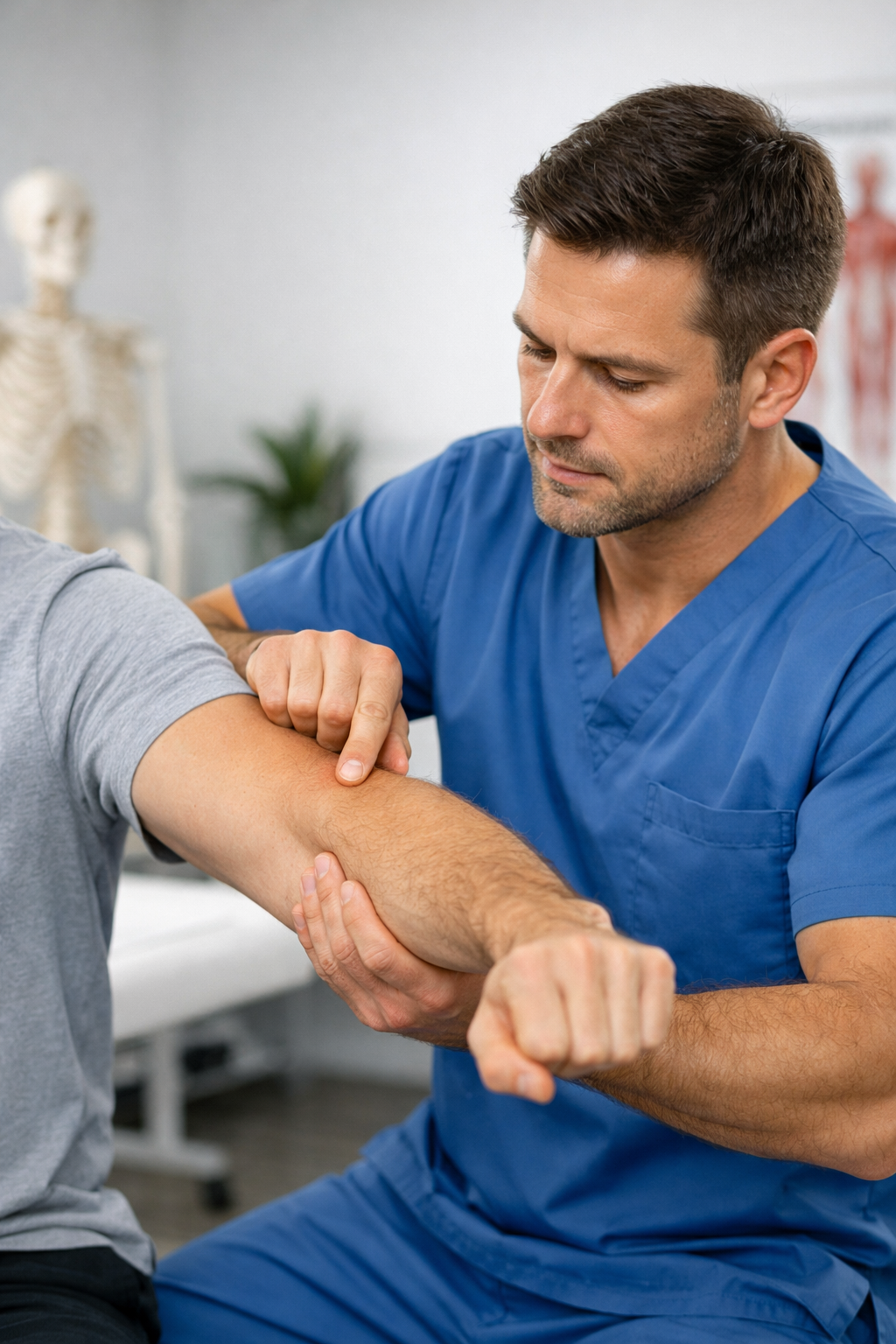
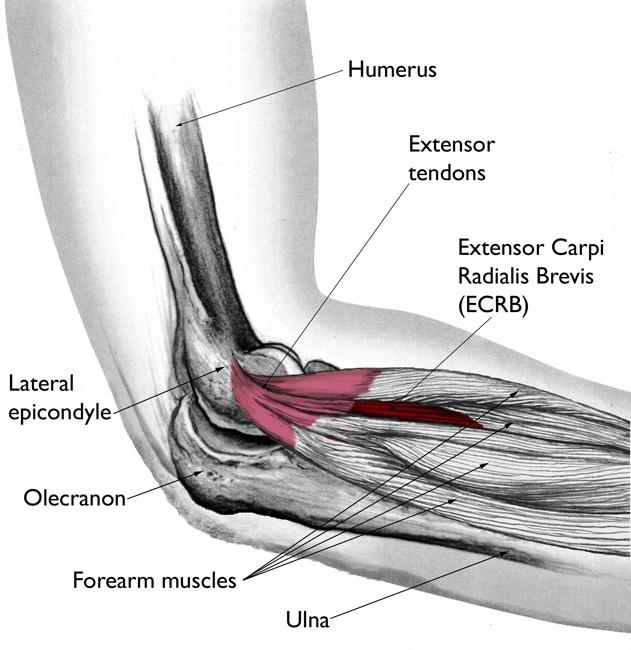
Tennis elbow — clinically known as lateral epicondylitis, lateral epicondylalgia, or lateral elbow tendinopathy — is an overuse condition affecting the tendons on the outer elbow. The primary structure involved is the extensor carpi radialis brevis (ECRB), a muscle-tendon unit that controls wrist extension and stabilizes the wrist during gripping. When subjected to repetitive stress, micro-tears and degenerative changes develop where the tendon attaches to the lateral epicondyle.
Despite its name, tennis elbow isn’t limited to tennis players. Repetitive movements at a keyboard, repetitive motions on a manufacturing line, and repetitive tasks in a warehouse all overload the same tendon. Symptoms include pain on the outer elbow that worsens with gripping, lifting, or twisting — turning a doorknob, shaking hands, or pouring from a kettle.
In Wayne, tennis elbow often truly is from tennis. But the town’s manufacturing base and corporate employers create a dual pathway to this condition. Understanding which pathway brought you here is critical, because effective tennis elbow management at Trinity Rehab starts by identifying the specific loads driving your symptoms.
Who's at Risk in Wayne?
Wayne’s demographics — median household income around $150,000, median age 41-42, twenty miles from Manhattan — create a community where occupational strain and recreational overuse converge on the lateral elbow. Here are three patient profiles Trinity Rehab Wayne sees frequently.
The Competitive Club Player
Sarah, 47, works remotely from her Packanack Lake home and plays competitive doubles at the Wayne Racquet Club three times per week, with winter platform tennis at the Municipal Complex. Her backhand leads with a slightly extended wrist, and her racket grip is a half-size too small. Over two months, a dull ache after matches has escalated to sharp pain mid-set.
This is classic tennis-related lateral epicondylitis — high match volume, a mechanical flaw, and ill-fitting equipment overloading her ECRB tendon past its tolerance threshold.
The Manufacturing and Logistics Worker
Miguel, 38, works at Saint-Gobain’s Wayne facility with sustained power-grip tool use and repetitive forearm pronation and supination each cycle. Previously he loaded pallets at Driscoll Foods. Weekends, he coaches his daughter’s NJ Play Sports soccer team at Captain Kilroy Park.
Miguel doesn’t play tennis, but years of cumulative gripping load have degraded his ECRB tendon just as effectively as a thousand backhands. Manufacturing and logistics workers at employers like UPS and Driscoll Foods represent a significant portion of tennis elbow cases in Wayne.
The Multi-Sport High School Athlete
Jake, 16, plays varsity tennis and lacrosse at Wayne Hills High School and trains at Wayne Indoor Tennis Club in the off-season. His volume climbed fast — recreational to competitive in eighteen months. The combination of tennis serve mechanics and lacrosse shooting created overlapping stress on his extensor tendons. His parents, William Paterson University alumni, recognized the warning signs and brought him to Trinity Rehab early.
Multi-sport athletes at Wayne Hills and Wayne Valley High School — combining tennis with lacrosse, golf, baseball, softball, or volleyball — are susceptible when training volume outpaces tissue adaptation. Early physical therapy leads to better outcomes and prevents lost playing time.
How Physical Therapy Treats Tennis Elbow at Trinity Rehab Wayne
Your physical therapist designs a phased program tailored to your activities, goals, and tendon state.
Phase 1: Pain Reduction and Load Management
The first priority is to reduce pain without pulling you entirely away from your activities. Your therapist assesses your tendon tolerance and establishes activity modifications — adjusting work ergonomics at Saint-Gobain or temporarily reducing match play at the Wayne Racquet Club.
Manual therapy plays a central role: soft tissue mobilization of the forearm muscles, lateral elbow joint mobilizations, and targeted wrist and shoulder work help reduce inflammation and restore movement. A counterforce strap may be recommended to offload the ECRB during daily tasks.
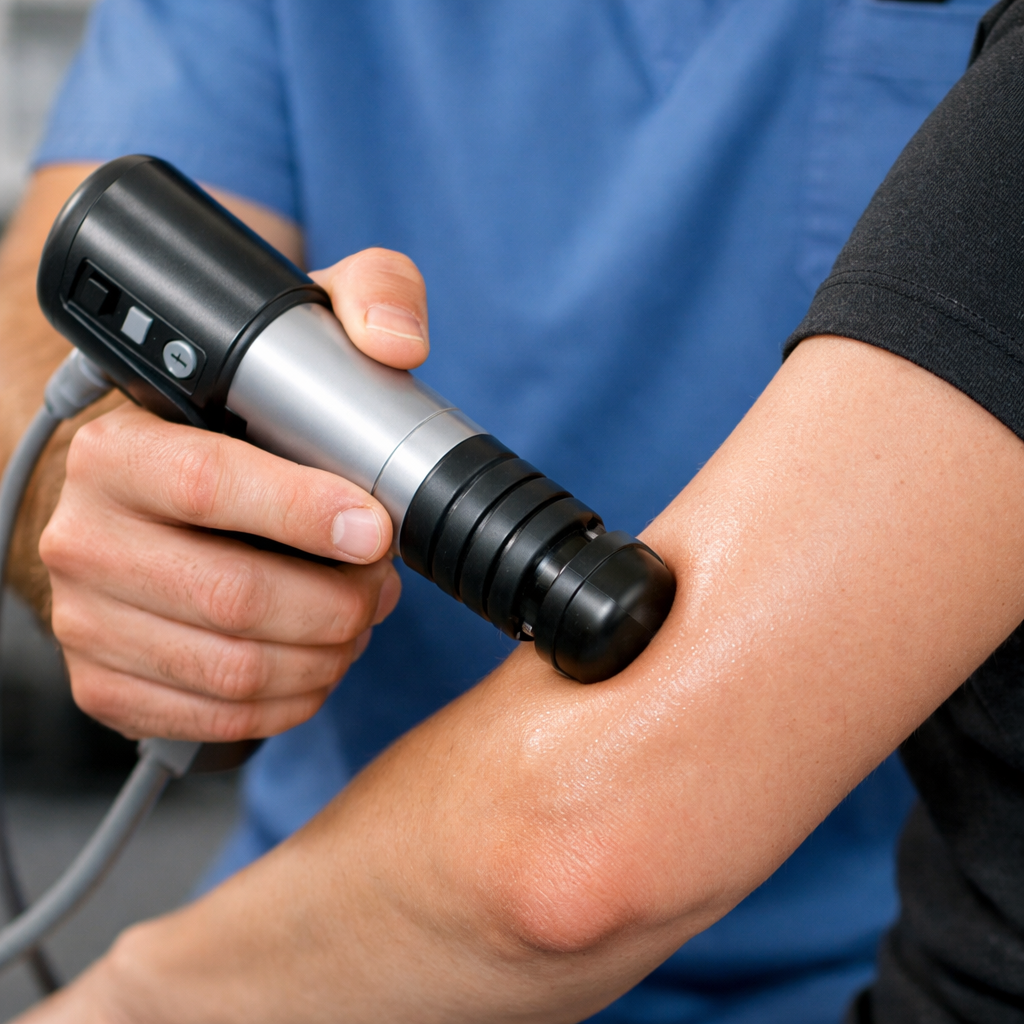
Trinity Rehab Wayne offers EPAT shockwave therapy, a non-invasive treatment delivering acoustic pressure waves to the damaged tendon. EPAT stimulates blood flow and cellular repair, providing meaningful pain relief without the risks of corticosteroid injections or surgery. Dry needling is also available — inserting thin needles into trigger points within the forearm muscles to release tension and improve local blood flow.
Phase 2: Progressive Strengthening
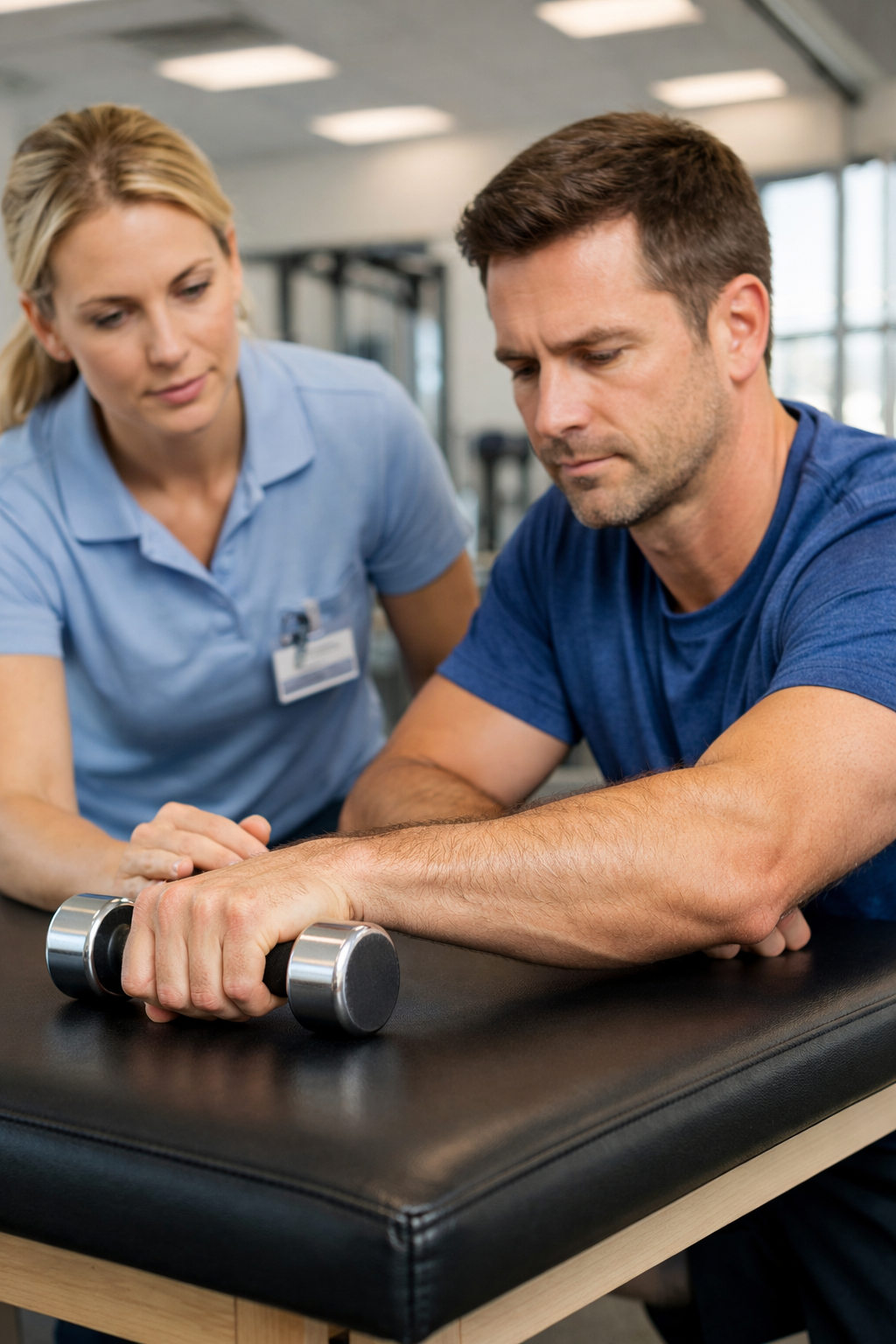
This is where eccentric exercise becomes the cornerstone. Eccentric loading — slowly lowering a weight with the wrist from extension into flexion — promotes tendon remodeling and increases long-term tendon tolerance. Your therapist guides you through:
- Wrist extension eccentric lowering with forearm supported and palm facing downward from a starting position on a table edge. Exercise slowly, in sets of 15.
- Grip strengthening using a tennis ball or therapy putty, progressing as grip strength returns.
- Forearm pronation and supination with a weighted tool, rebuilding rotational strength.
- Towel twists — wringing a rolled towel in both directions for forearm endurance.
- Wrist stretches performed with the arm outward and shoulders relaxed, held 30 seconds.
Each exercise stays within your tendon’s current tolerance while progressively expanding it. Your therapist monitors response and adjusts intensity accordingly.
Phase 3: Sport-Specific Rehab and Return to Activity
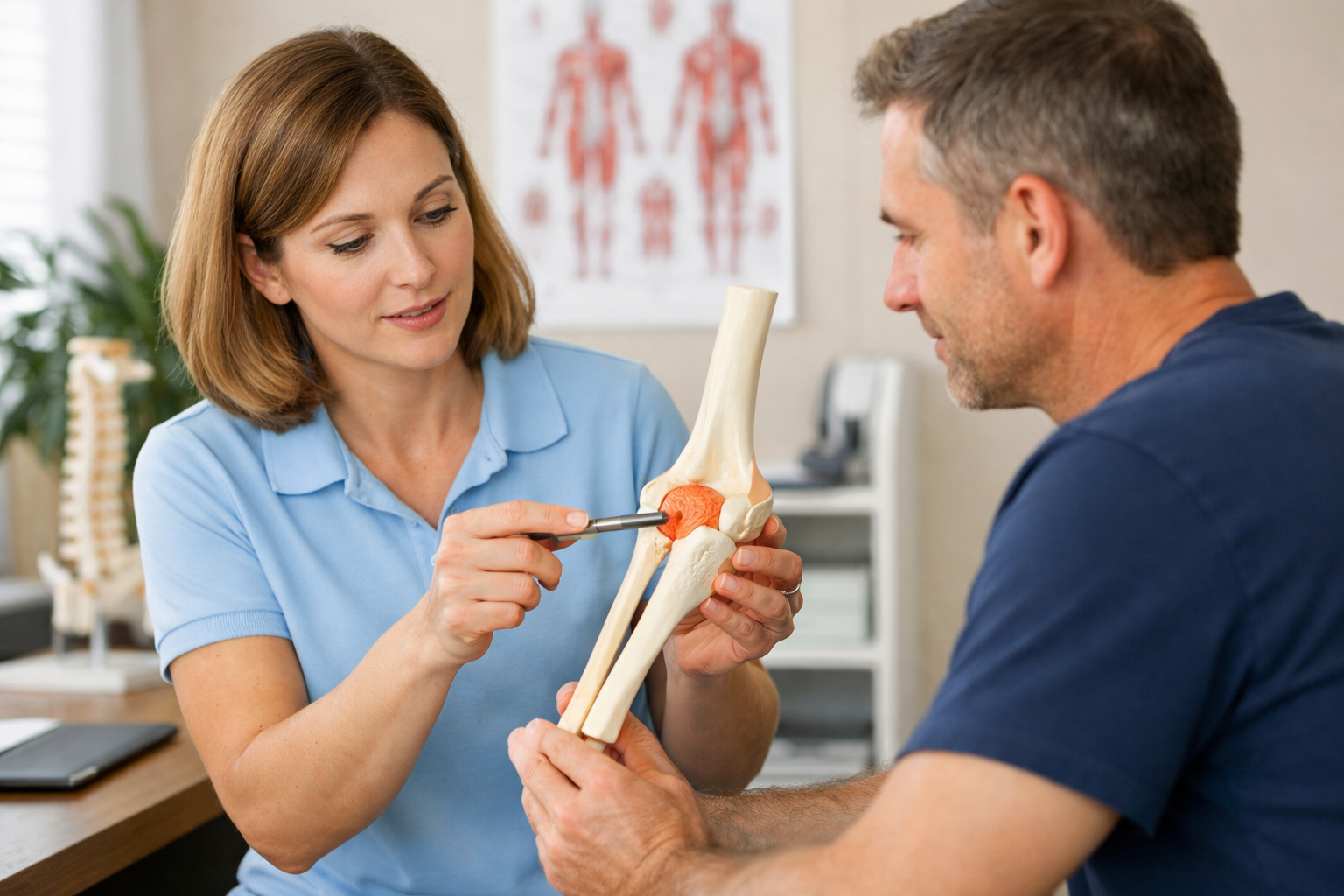
Trinity Rehab Wayne’s sports med expertise means rehabilitation continues until you perform at your pre-injury level. For tennis and platform tennis players, this includes serve mechanic analysis, racket grip assessment, and a gradual return-to-sport protocol — rallying before points, shorter sessions before full matches.
For workers, the plan focuses on workplace ergonomics, tool selection, and pacing. For high school athletes with long term goals across seasons, it addresses cumulative load and periodization to prevent recurrence.
Why Choose Trinity Rehab Wayne?
One-on-one personalized care. Every session is with a licensed physical therapist who knows your history and adjusts your plan in real time. For tennis elbow — where tendon tolerance shifts weekly — this attention drives recovery.
Advanced technology. EPAT shockwave therapy, dry needling, and expert manual therapy allow your therapist to treat tennis elbow from multiple angles, accelerating pain relief beyond what exercises alone achieve.
Direct Access. Under New Jersey law, you can start physical therapy without a physician referral. Schedule the moment elbow pain interferes — no waiting, no delay.
Sports medicine expertise. Whether you play sports like tennis, platform tennis, pickleball, or racquetball, your therapist evaluates your movement patterns, recommends equipment needed for safer play, and builds a return-to-sport plan around your game.
Convenient location. Easily accessible for Wayne, Packanack Lake, Pines Lake, Pompton Lakes, and Little Falls residents.
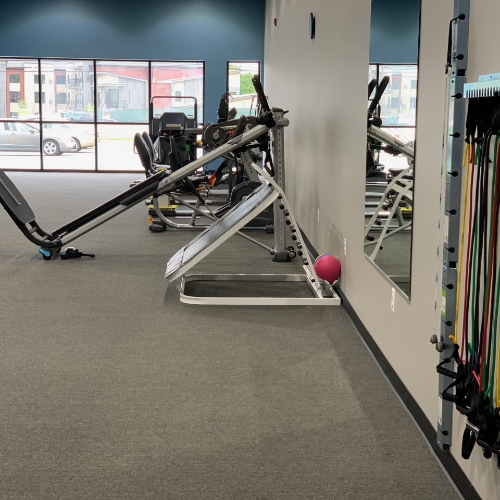
Inside Our Wayne Clinic
Related Conditions & Treatments
Tennis elbow is just one of the many conditions we treat at Trinity Rehab Wayne. Explore our full range of conditions we treat or learn more about specific treatment approaches:
- Tennis Elbow Treatment Overview — Our comprehensive guide to lateral epicondylitis recovery
- Elbow, Wrist & Hand Pain Relief — Other upper extremity conditions we specialize in
- Shoulder Pain Relief — Treatment for rotator cuff, frozen shoulder, and more
- Manual Therapy — Hands-on techniques to restore joint mobility and reduce pain
- Dry Needling — Trigger point therapy for deep muscle tension and pain relief
Related Elbow Care At This Location
Elbow pain can come from different tendon and loading patterns around the joint. A related same-location page is:
Frequently Asked Questions
Can I still play tennis while getting treatment for tennis elbow?
What is platform tennis, and can it cause tennis elbow?
How is EPAT different from cortisone shots for tennis elbow?
Does Trinity Rehab Wayne offer sports-specific rehabilitation?
How can I prevent tennis elbow from coming back?
Wayne’s courts are waiting. Whether it’s Thursday doubles at the Wayne Racquet Club, a weekend platform tennis match at the Municipal Complex, or getting through your workday at Saint-Gobain without wincing — you deserve to move without pain. Tennis elbow is treatable, and with the right physical therapy, recovery is predictable.
Get back to playing pain-free — schedule your appointment at Trinity Rehab Wayne today.