
Degenerative Disc Disease Treatment
Back pain, neck pain, stiffness, or sciatica from disc degeneration can interrupt daily life. Trinity Rehab helps patients across New Jersey and Pennsylvania calm symptoms, build strength, and move with confidence.
Medically reviewed by Michael Montalbano, PT, DPT, OCS · Updated 2026-05-18
What Degenerative Disc Disease Means
Degenerative disc disease describes changes in the intervertebral disc, the shock-absorbing structure between the bones of the spine. Over time, a disc may lose hydration, become less flexible, lose disc height, or develop small tears. These changes can affect the lumbar spine in the low back, the cervical spine in the neck, or more than one level of the spine. Some people feel pain from these changes. Others have imaging findings and very little pain. That is why a careful physical therapy evaluation matters more than treating a scan alone.
DDD is not the same thing as being broken, fragile, or destined for surgery. Many patients improve by learning how to calm irritated tissue, move without guarding, strengthen the muscles that support the spine, and build a realistic plan for sitting, lifting, standing, walking, sleep, work, and exercise. Physical therapy cannot reverse the age of a disc, but it can often change how much the spine hurts and how well it functions.
The name can sound intimidating, but disc degeneration is often part of normal spine aging. The real question is whether your symptoms, strength, mobility, nerve signs, posture, and daily function can improve with the right plan. At Trinity Rehab, the focus is practical recovery: less pain, stronger support, better movement, and more confidence in the activities you actually need to do.
That patient-first framing keeps the page medically accurate while still answering the urgent search question: where can I get useful spine care now?

Common Symptoms
Degenerative disc disease symptoms vary because the disc, joints, nerves, muscles, and surrounding tissues can all contribute. Some patients have local back pain or neck pain. Others have stiffness that builds with sitting, pain that worsens with bending or lifting, or symptoms that travel into the buttock, thigh, leg, shoulder, arm, or hand when a nerve is irritated.
- low back pain
- neck pain
- stiffness after sitting
- pain with bending or lifting
- pain with standing or walking
- pain that comes and goes
- buttock or leg symptoms
- numbness or tingling
- weakness
- difficulty with stairs or daily activity
- pain that improves when you change positions
- flare-ups after yard work, travel, driving, or heavy activity
- reduced confidence with lifting, exercise, stairs, or longer walks
Seek urgent medical care for loss of bladder or bowel control, numbness in the groin or saddle area, rapidly worsening weakness, fever with severe spine pain, unexplained weight loss, major trauma, or severe new symptoms with a history of cancer.
Why It Can Create Back Pain, Neck Pain, Or Sciatica
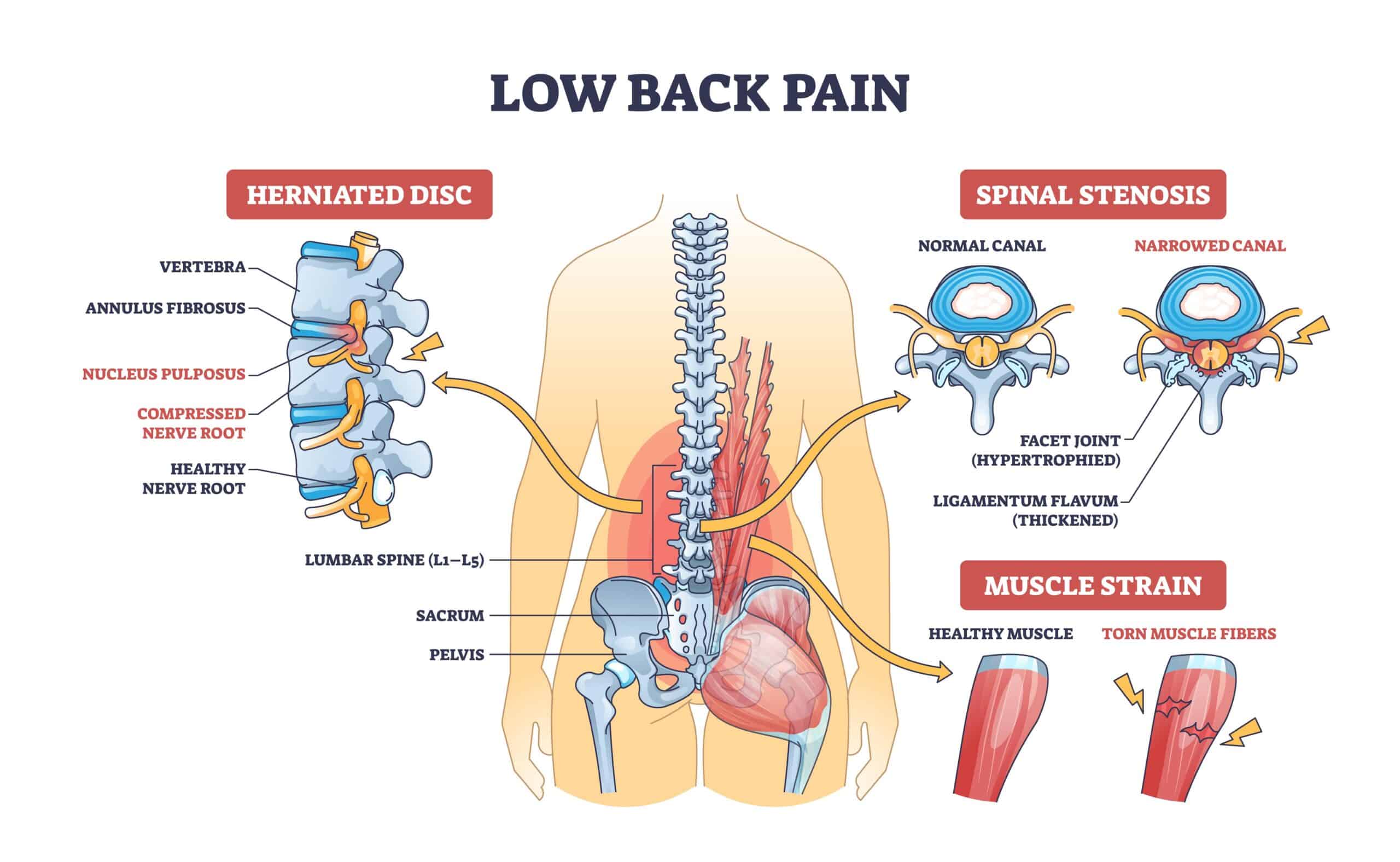
Disc degeneration can be related to several overlapping problems. A thinner disc may change how forces move through the spine. Nearby joints may become irritated by arthritis. A herniated disc, disc height loss, or stenosis can contribute to nerve irritation or radiculopathy. Muscles may tighten around the painful area, and fear of movement can make the back or neck feel even more guarded.
Good spine rehab looks for modifiable factors. Your therapist is not trying to prove that every symptom comes from one disc. The evaluation asks better questions: which movements reproduce your pain, which positions calm it, whether nerve symptoms are present, whether your hips and core can support the lumbar spine, whether the cervical spine is moving well, and whether your daily routine keeps triggering the same flare-up.
Related Conditions We Consider
Degenerative disc disease often overlaps with spinal arthritis, lumbar disc herniation, sciatica, radiculopathy, spinal stenosis, posture-related pain, post-surgical rehabilitation, and general low back pain or neck pain. Your plan should account for the full presentation, not just the diagnostic label.
Imaging, Pain, And Function
One of the most important parts of degenerative disc disease education is separating imaging from destiny. X-rays and MRIs can show disc height changes, arthritis, stenosis, herniated disc findings, or other age-related changes. They are useful pieces of information, but they do not automatically explain every symptom. A scan does not show how well you bend, lift, walk, sleep, sit, climb stairs, or tolerate daily activity.
That difference matters for patients who have been told they have disc degeneration and then become afraid to move. Avoiding movement may feel protective at first, but too much rest can reduce strength, mobility, conditioning, and confidence. The right plan respects pain while gradually rebuilding the ability to move.
At Trinity Rehab, we use the imaging story when it is available, but we also test what can change. If your pain improves with position, mobility, strength, nerve-sensitive movement, walking progression, or better load management, those are useful treatment signals. The goal is not to argue with the diagnosis. The goal is to find the practical path forward.
How Trinity Rehab Evaluates Degenerative Disc Disease
Your first visit is built around clarity. We want to understand what hurts, what makes it better or worse, which activities you are avoiding, whether nerve symptoms are involved, and what you need your spine to tolerate in real life. For one patient, the goal may be sitting through work without back pain. For another, it may be walking the neighborhood, lifting a grandchild, returning to golf, handling a physically demanding job, or sleeping without waking from neck pain.
- symptom history, medical history, and red flag screening
- lumbar spine or cervical spine range-of-motion testing
- nerve screening for sensation, strength, reflexes, and symptom behavior when needed
- core, hip, shoulder, and leg strength testing as appropriate
- posture, lifting, sitting, walking, balance, stairs, and daily movement review
- discussion of imaging, physician instructions, injections, surgery history, or medications when relevant
- a home exercise plan that supports progress between visits
Patients in New Jersey and Pennsylvania may be able to start physical therapy through direct access when appropriate. If your symptoms suggest that imaging, physician follow-up, or urgent medical evaluation is needed, your therapist will guide that next step.
Physical Therapy Treatment Plan
Treatment should not be a random sheet of back exercises. Degenerative disc disease physical therapy works best when it is staged to your irritability and goals. Early care often focuses on pain modulation, education, positions of relief, mobility, and gentle activation. As symptoms calm, the plan progresses into strengthening, conditioning, body mechanics, walking tolerance, and confidence with the tasks that matter most.
Phase 1: Calm The Flare-Up
Your therapist may use education, activity modification, manual therapy, gentle mobility, breathing strategies, heat or cold guidance, and symptom-specific exercises to reduce guarding. The goal is to keep you moving without repeatedly aggravating the same area.
Phase 2: Restore Mobility And Control
Once pain is less irritable, therapy may focus on spine mobility, hip mobility, cervical motion, nerve mobility when appropriate, postural endurance, and better control during sitting, standing, stairs, bending, and walking.
Phase 3: Build Strength And Load Tolerance
Core strength, hip strength, glute strength, leg strength, upper-back support, and gradual cardiovascular conditioning help the spine tolerate daily stress. This is where therapeutic exercise becomes specific to your job, commute, hobbies, sport, or home routine.
Phase 4: Prevent Recurrence
DDD tends to have ups and downs. A strong plan gives you a flare-up strategy, a home exercise program, body mechanics for lifting and bending, and a realistic way to keep moving after discharge.



What Makes Trinity's DDD Pages Different
The large regional chains often publish one generic spine article and then attach a location finder. Trinity's model is more useful for patients and stronger for local search because the hub explains the condition in depth while each spoke connects that condition to a real clinic, address, phone number, review widget, nearby communities, and the daily routines patients are searching about in that market.
For organic SEO, the hub helps Google understand the condition topic across the site. The spokes help Trinity compete for searches like degenerative disc disease physical therapy near me, back pain treatment in Metuchen NJ, sciatica physical therapy in Toms River NJ, and spine physical therapy in Upper Dublin PA. Each page must be medically careful, locally specific, conversion-ready, and technically clean.
How Progress Is Usually Measured
A strong degenerative disc disease plan should measure more than pain on a scale of zero to ten. Pain matters, but function tells the fuller story. Can you sit longer with less stiffness? Can you stand up from a chair without bracing? Can you walk farther before symptoms build? Can you bend, lift, turn, drive, sleep, exercise, or work with more confidence? Those changes show whether the spine is becoming more tolerant.
Progress also includes knowing what to do when a flare-up happens. Many patients with disc degeneration will still have occasional bad days. That does not mean the plan failed. It means the plan should give you tools: movements that calm symptoms, activities to temporarily modify, strength work to maintain, and signs that tell you when to call your therapist or physician.
The best outcome is not just a short-term reduction in pain. It is a patient who understands their back or neck, knows how to manage symptoms, and has a realistic strength and mobility routine that keeps life moving.
This is also where Trinity's one-on-one outpatient model helps the SEO page match the real care model. The page can explain disc degeneration, but the visit turns that education into a practical sequence: calm the current irritation, restore useful mobility, build core and hip support, reintroduce walking and lifting, and leave the patient with a plan they can keep using after discharge.
Find Degenerative Disc Disease Treatment Near You
Choose your closest Trinity Rehab clinic for localized degenerative disc disease physical therapy information. Spokes are intentionally not top-menu pages; they are built for patients searching by condition plus location.
- Brick, NJ
- Cherry Hill, NJ
- Clark, NJ
- Clifton, NJ
- East Brunswick, NJ
- East Windsor, NJ
- Emerson, NJ
- Flemington, NJ
- Hamilton, NJ
- Howell, NJ
- Manalapan, NJ
- Matawan, NJ
- Metuchen, NJ
- Middletown, NJ
- Piscataway, NJ
- Sewell, NJ
- Shrewsbury, NJ
- Somerset, NJ
- Somerville, NJ
- Sparta, NJ
- Toms River, NJ
- Warren, NJ
- Wayne, NJ
- Woodbridge, NJ
- Doylestown, PA
- Newtown, PA
- Upper Dublin, PA
Related Spine And Pain Pages
Degenerative disc disease can overlap with several spine, nerve, and joint conditions. These related pages can help patients understand symptoms that may appear together.
Patient Reviews
Reviews help patients see that Trinity Rehab is not just a content page. It is a real clinic network with real patient experiences across New Jersey and Pennsylvania.
Frequently Asked Questions
Is degenerative disc disease actually a disease?
Despite the name, degenerative disc disease usually describes age-related disc changes in the spine. Many people have disc degeneration on imaging without severe symptoms. The important question is whether your symptoms, strength, mobility, nerve signs, and daily function match what is seen on an X-ray or MRI.
Can physical therapy reverse disc degeneration?
Physical therapy does not reverse disc height loss or make a worn disc young again. The goal is to reduce pain, improve mobility, build core and hip strength, calm nerve irritation when present, and help the spine tolerate sitting, bending, lifting, standing, walking, and exercise with less fear and less flare-up behavior.
Do I need an MRI before starting physical therapy?
Many people can begin physical therapy based on symptoms, history, and a movement exam, especially when there are no red flags. Imaging can be useful when symptoms are severe, progressive, traumatic, or not improving as expected. Your therapist will refer you back to a physician if your presentation suggests that medical workup is needed.
What symptoms suggest nerve irritation?
Pain that travels into the buttock or leg, numbness, tingling, weakness, foot drop, or symptoms that change with spine position can suggest nerve irritation or radiculopathy. These symptoms deserve a careful exam so the plan protects the nerve while rebuilding movement tolerance.
How long does physical therapy take for degenerative disc disease?
It depends on irritability, strength, mobility, nerve involvement, work demands, and how long symptoms have been present. Many patients start with a plan over several weeks, then transition toward independent strength, mobility, walking, and flare-up management.
When should back or neck symptoms be urgent?
Seek urgent medical care for new loss of bladder or bowel control, numbness in the groin or saddle area, rapidly worsening leg weakness, fever with severe spine pain, unexplained weight loss, major trauma, or severe symptoms with a history of cancer.
Start With A Clear Plan
If degenerative disc disease, disc degeneration, back pain, neck pain, sciatica, or stiffness is changing how you move through the day, start with an evaluation. The goal is to understand what is driving your symptoms and build a plan you can actually follow.