

TENNIS ELBOW TREATMENT IN MATAWAN, NJ | TRINITY REHAB
Matawan is one of those places that surprises people. Tucked into northern Monmouth County with just under 9,700 residents, the borough has the feel of a town where everybody knows each other — but the energy of a community that refuses to slow down. The Aberdeen-Matawan train station sends a steady stream of commuters into New York City every morning, and by the time they get home, they’re lacing up sneakers, grabbing paddles, or hauling kayaks down to Lake Lefferts before the sun dips behind the tree line.
That blend of desk-bound workdays and packed evenings is what makes Matawan such a great place to live — and also what makes it a hotspot for overuse injuries like tennis elbow.
Picture this: you’re a project manager who spends nine hours gripping a mouse and hammering a keyboard in Midtown. You catch the 5:47 back to Aberdeen-Matawan, swing by the house, and head to Pickleball HQ for Tuesday league night. Wednesday it’s the Jersey 34 Tennis Club for doubles. Saturday you’re paddling Matawan Creek or biking the Henry Hudson Trail from the Cheesequake trailhead. By month three, you notice a dull ache on the outside of your elbow. By month four, you can barely shake a hand without wincing. The pain keeps creeping back every time you grip a racket, twist a doorknob, or lift your morning coffee.
That nagging ache has a name: lateral epicondylitis. And at Trinity Rehab Matawan, we treat it every single week.
Before you resign yourself to giving up league night or skipping your weekend paddle past the Burrowes Mansion shoreline, know this — tennis elbow is treatable, and physical therapy is the most effective path back to full function. No surgery. No endless cortisone shots. Just structured, progressive rehab guided by a physical therapist who understands the demands of your life.
What Is Tennis Elbow?
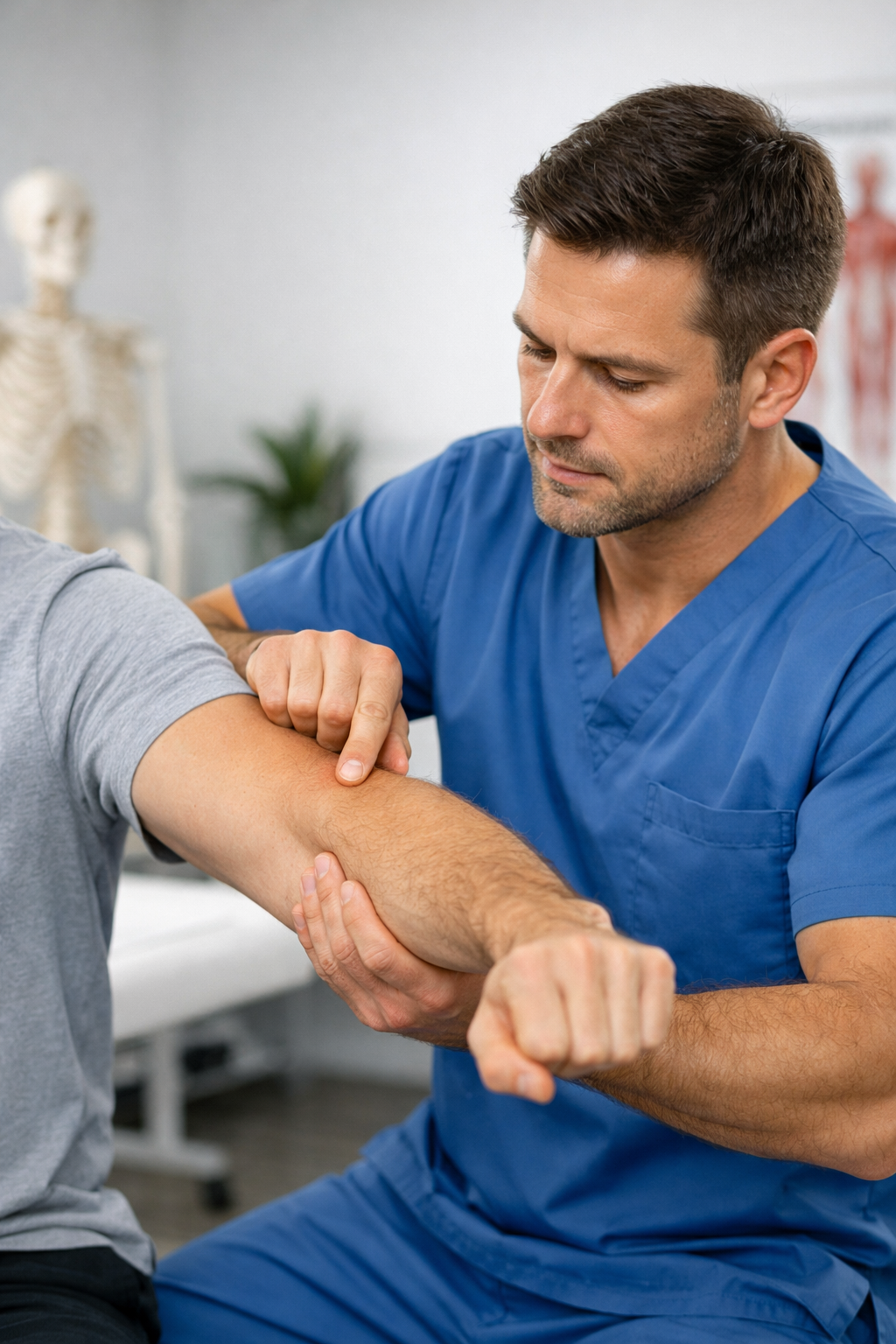
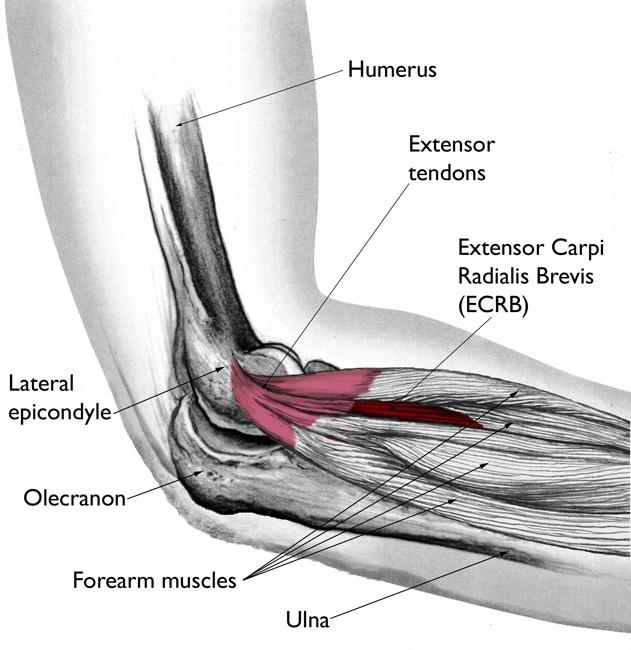
Tennis elbow — known clinically as lateral epicondylitis, lateral epicondylalgia, or lateral elbow tendinopathy — is a condition affecting the tendons on the outside of the elbow at the lateral epicondyle. The primary structure involved is the extensor carpi radialis brevis (ECRB), a forearm muscle that stabilizes the wrist when the elbow is straight. When this tendon endures repetitive stress, micro-damage accumulates faster than the tissue can repair itself, producing pain, weakness, and a frustrating inability to do things you once took for granted.
What catches most people off guard is that tennis elbow rarely arrives with a dramatic moment. It’s the accumulated strain from months of repetitive movements — gripping, twisting, reaching, lifting — that gradually overwhelms the tendon. Repetitive motions at work, repetitive tasks around the house, and repetitive forehands on the court all feed the same problem. The tendon erodes layer by layer until one morning you can’t pour milk without pain shooting down your forearm.
This is why tennis elbow management matters. Without proper treatment, the condition can persist for years. Corticosteroid injections may offer short-term pain relief, but research shows they lead to worse long-term outcomes compared to physical therapy. Surgery is rarely necessary when rehab is done correctly. The key is building tendon tolerance to match the demands placed on it — not just masking symptoms.
Who's at Risk in Matawan?
Matawan’s median age is 36 — squarely in the sweet spot for tennis elbow. Old enough that tendons don’t bounce back as effortlessly as they did at twenty, young enough that nobody is ready to dial back their activity level. Combine that with the commuter lifestyle, local sports culture, and the warehouse and healthcare jobs along Routes 34 and 35, and you have a community where lateral elbow pain is remarkably common.
Here are three patient profiles we see regularly at Trinity Rehab Matawan:
The Commuter-Athlete
Sarah is 34 and catches the NJ Transit train from Aberdeen-Matawan five mornings a week to work in finance. Her wrist stays cocked in extension for hours over a laptop. Evenings, she plays at the Jersey 34 Tennis Club — indoor courts in winter, outdoor leagues in summer — and recently picked up pickleball at Pickleball HQ. She kayaks Lake Lefferts on weekends and hikes Cheesequake State Park. Sarah didn’t connect her elbow pain to her lifestyle until she couldn’t hold her paddle through a full match. Her physical therapist at Trinity Rehab helped her see that sustained desk-grip postures combined with high-intensity racket sports were overloading her ECRB far beyond its capacity.
The Warehouse Worker
Marcus works at a distribution facility along the Route 34/35 corridor. His shifts involve scanning packages with a handheld device, lifting boxes, and palletizing shipments — repetitive tasks demanding constant gripping and forearm engagement. His tennis elbow came entirely from occupational strain. The scanner grip alone — thumb pressed against a trigger eight hours a day — pushed his extensor tendons past their limit. Marcus assumed the pain was “just part of the job” until a coworker recommended Trinity Rehab. Within weeks of targeted treatment and activity modifications, his symptoms started turning around.
The High School Athlete
Jake is a junior at Matawan Regional High School, where the Huskies compete in the Shore Conference. He plays shortstop — quick, snapping throws from the hole put significant stress on the lateral elbow, especially when he’s fielding five days a week and hitting in the cage on off days. His coach noticed he was short-arming throws to first, and the athletic trainer flagged lateral elbow tenderness. Jake’s parents brought him to Trinity Rehab Matawan, where his physical therapist designed a program focused on eccentric loading, forearm strengthening, and a return-to-throw progression that kept him on the roster while his tendon healed.
How Physical Therapy Treats Tennis Elbow at Trinity Rehab Matawan
Treating tennis elbow effectively requires more than rest and ice. At Trinity Rehab Matawan, we use a phase-based approach that rebuilds tendon tolerance from the ground up.
Phase 1: Pain Reduction and Load Management
The first priority is to reduce pain and calm the irritated tendon. Your physical therapist will assess your elbow, wrist, forearm, and shoulder to identify the movements driving your symptoms, then implement activity modifications tailored to your routine — adjusting your desk setup, modifying your grip technique, or recommending a counterforce strap to offload the tendon during work or play sports.
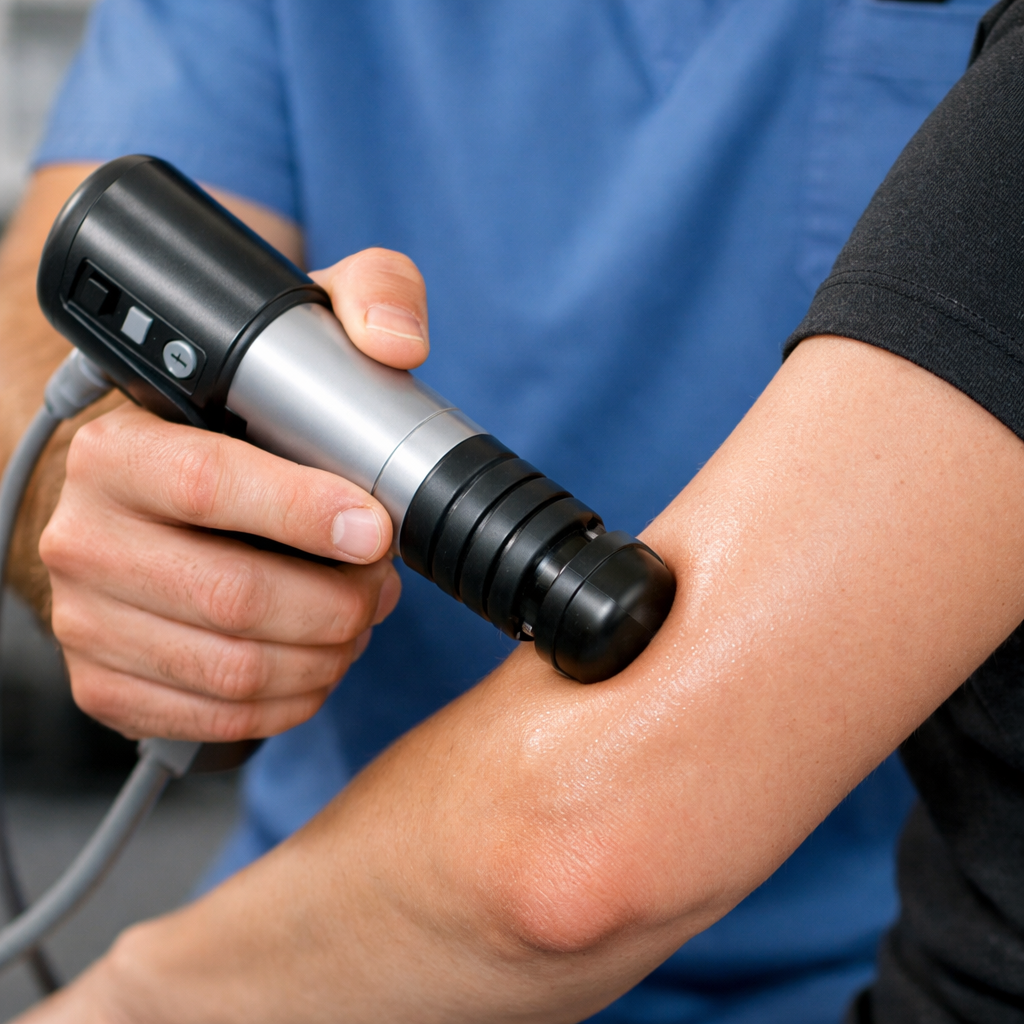
Manual therapy plays a central role here. Soft tissue mobilization of the forearm muscles, joint mobilization, and targeted stretching help reduce inflammation and prepare tissue for strengthening. We may incorporate dry needling to release trigger points in the forearm extensors, improving blood flow and reducing pain. For stubborn cases, EPAT shockwave therapy delivers acoustic energy to the tendon, stimulating the body’s natural healing response.
Phase 2: Progressive Strengthening
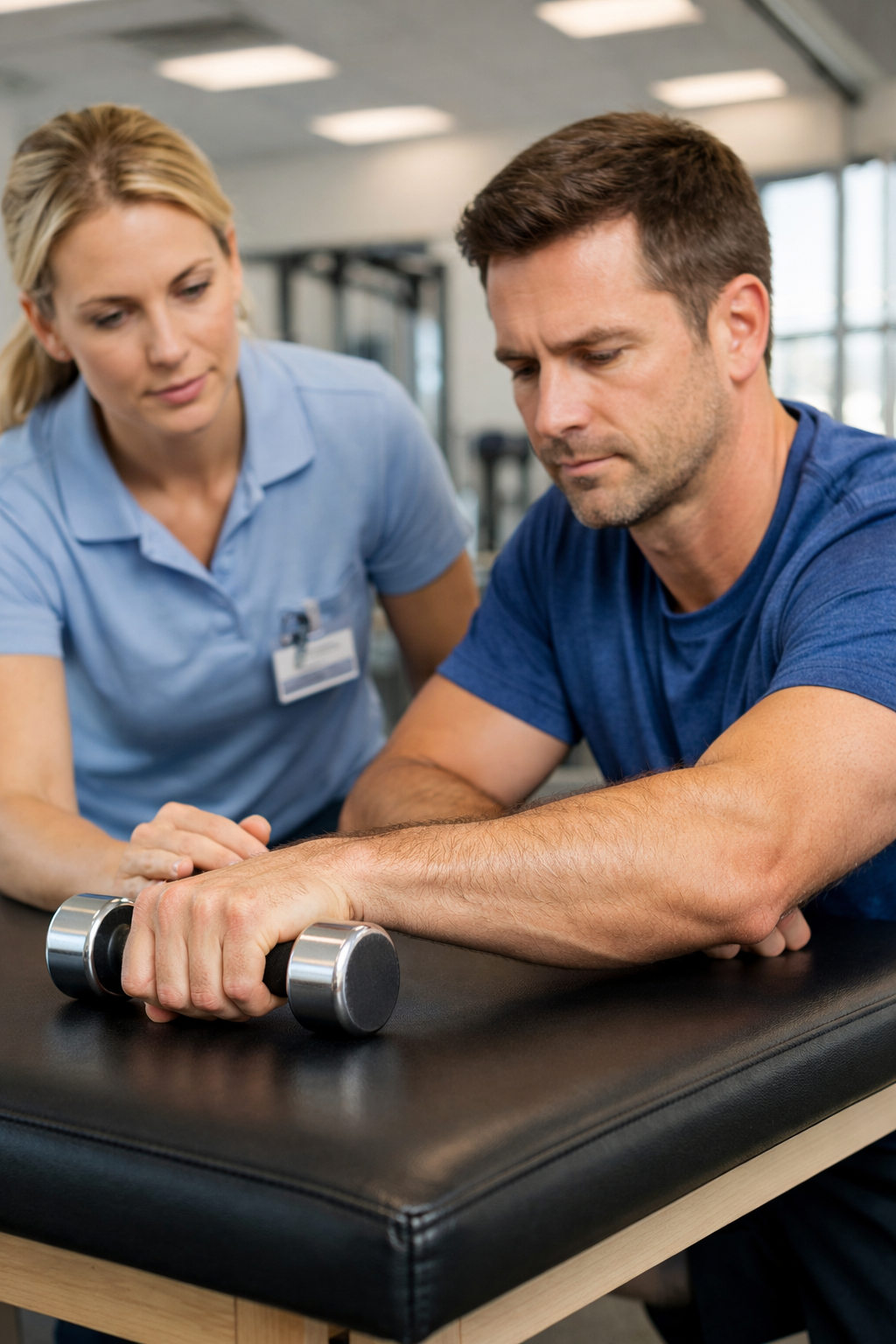
Once pain is controlled, we build the tendon’s capacity to handle load — this is where real recovery happens. Eccentric exercise is the gold standard for tendon rehabilitation. A classic example: holding a light dumbbell with your palm facing down from the starting position, slowly lowering the wrist, and using the other hand to reset. You exercise slowly, training the ECRB to absorb force without breaking down.
We progress through wrist extension exercises, forearm pronation and supination drills, grip strengthening with therapy putty, and functional movements like towel twists to build rotational forearm endurance. Each exercise is dosed carefully — your physical therapist adjusts the program week by week, pushing toward greater tendon tolerance without crossing the pain threshold. No special equipment needed beyond what we provide in the clinic and simple tools for your home program.
Phase 3: Return to Activity
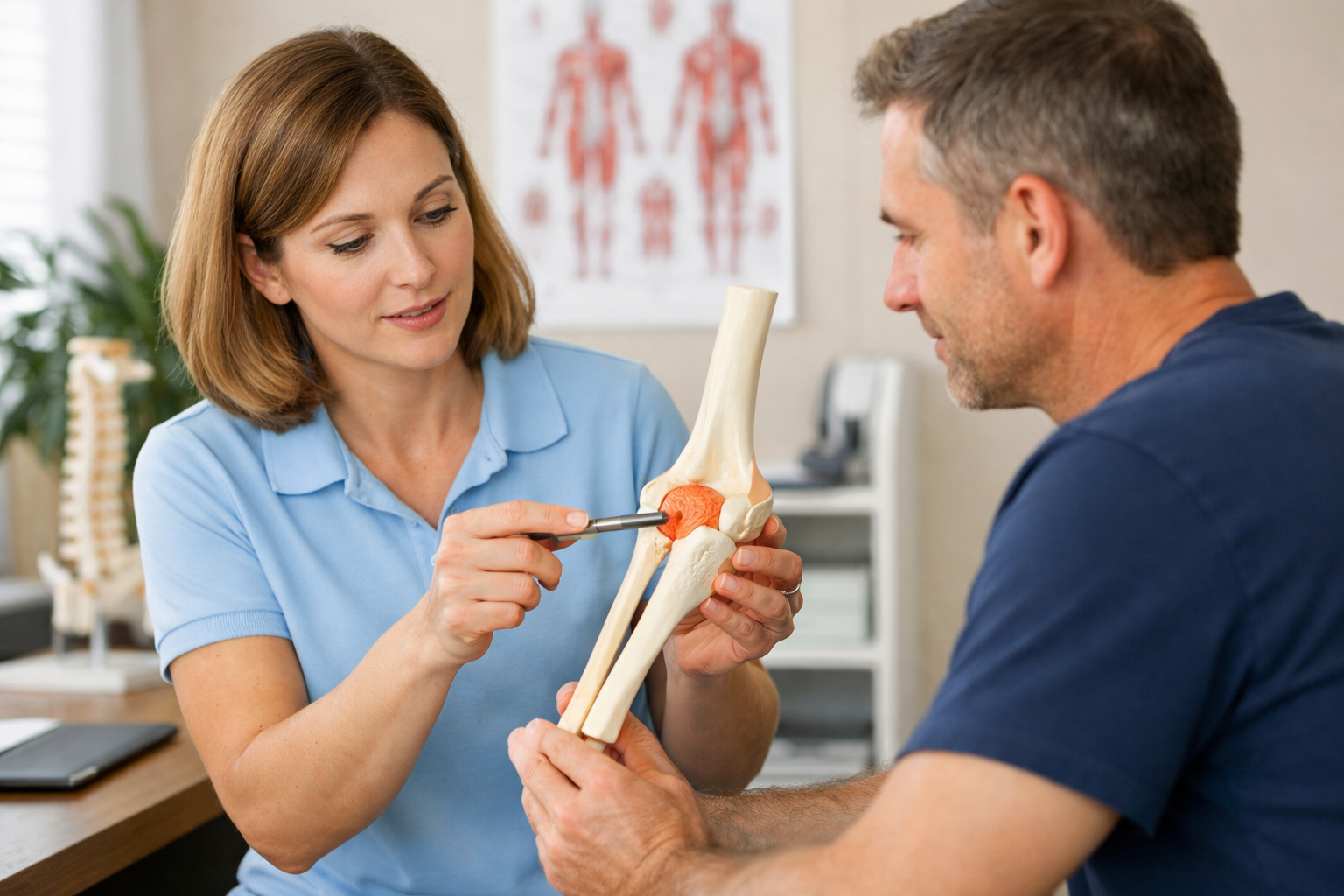
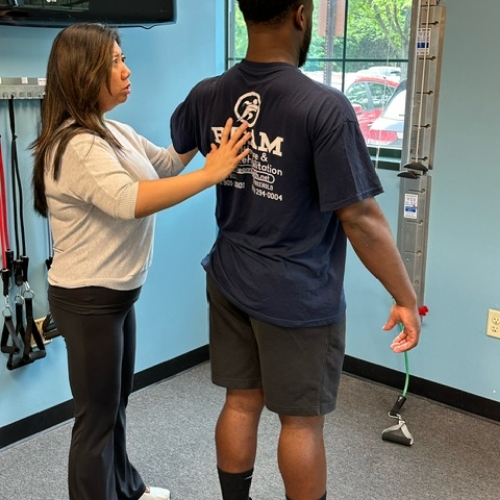
The final phase bridges the gap between the clinic and your life. For the commuter-athlete, that means sport-specific drills and a gradual return to match play at the Jersey 34 Tennis Club or Pickleball HQ. For the warehouse worker, it means grip-endurance training that mirrors scanner use and box handling, shoulders relaxed and arm outward in positions that minimize strain. For the high school athlete, it means a structured throwing program with close monitoring.
Throughout every phase, we focus on your long-term goals — not just getting you out of pain today, but making sure tennis elbow doesn’t come back.
Why Choose Trinity Rehab Matawan?
One-on-one care, every visit. You work directly with your physical therapist for the entire session — no aides, no machine circuits. This personalized approach means better outcomes and a plan that fits your life.
Advanced technology. Our Matawan clinic offers EPAT shockwave therapy, dry needling, and skilled manual therapy, allowing us to treat tennis elbow at every stage from acute pain to return-to-sport.
Direct Access — no referral needed. New Jersey law lets you see a physical therapist without a physician referral. Call Trinity Rehab Matawan today and schedule an evaluation without waiting for a doctor’s appointment first.
Convenient for the whole community. We serve Matawan, Aberdeen, Keyport, and Holmdel — easily accessible for commuters passing through the Aberdeen-Matawan train station corridor.
Inside Our Matawan Clinic
Related Conditions & Treatments
Tennis elbow is just one of the many conditions we treat at Trinity Rehab Matawan. Explore our full range of conditions we treat or learn more about specific treatment approaches:
- Tennis Elbow Treatment Overview — Our comprehensive guide to lateral epicondylitis recovery
- Elbow, Wrist & Hand Pain Relief — Other upper extremity conditions we specialize in
- Shoulder Pain Relief — Treatment for rotator cuff, frozen shoulder, and more
- Manual Therapy — Hands-on techniques to restore joint mobility and reduce pain
- Dry Needling — Trigger point therapy for deep muscle tension and pain relief



Related Elbow Care At This Location
Elbow pain can come from different tendon and loading patterns around the joint. A related same-location page is:
Frequently Asked Questions
What’s the difference between tennis elbow and a pinched nerve?
Can I keep playing pickleball during tennis elbow treatment?
Does Trinity Rehab Matawan offer evening appointments for commuters?
Do I need a referral to see a physical therapist in New Jersey?
Is dry needling effective for tennis elbow?
Whether it’s paddling Lake Lefferts on a Saturday morning, grinding out a third set at the Jersey 34 Tennis Club, dominating league night at Pickleball HQ, or just getting through the workday — get your elbow right.
Schedule your appointment at Trinity Rehab Matawan today. No referral needed. Call us or visit our website to book your evaluation and take the first step toward lasting pain relief and full recovery.