
TENNIS ELBOW TREATMENT IN CLIFTON, NJ | TRINITY REHAB
Clifton is not a quiet suburb. It is a dense, diverse, fast-moving city of 90,000 where the Route 3 and Route 46 corridors hum with warehouse trucks before sunrise and the parks fill with pickleball players by late afternoon. People here work hard — UPS distribution shifts, Costco stock runs, Home Depot lumber hauls — and when the shift ends, they decompress across 39 parks and more than 210 acres. They hit the courts at Albion Memorial Park, walk the loop at Main Memorial Park, hike Garret Mountain, or squeeze in nine holes at Upper Montclair Country Club.
That grind-and-play combination is what makes Clifton what it is — and what makes tennis elbow one of the most common arm injuries Trinity Rehab Clifton treats.
Lateral epicondylitis does not care whether your forearm got overloaded scanning packages on a conveyor belt or smashing a pickleball at Albion Park. It only cares that the tendon took more than it could handle. In a working city like Clifton, that happens constantly.
What Is Tennis Elbow?
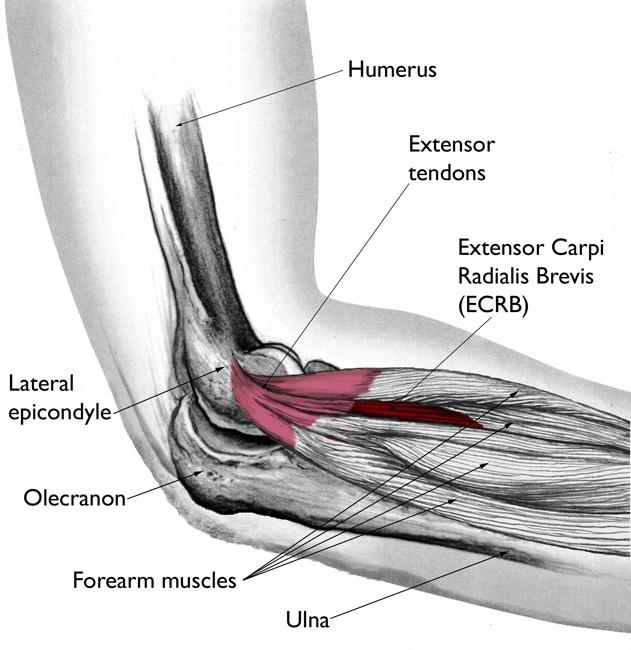
Tennis elbow — also called lateral epicondylitis, lateral epicondylalgia, or lateral elbow tendinopathy — is a degenerative overuse condition of the tendons on the outside of the elbow. The primary structure involved is the extensor carpi radialis brevis (ECRB), the muscle-tendon unit that stabilizes the wrist during gripping and wrist extension. Repeated stress causes micro-tears and degenerative changes at the tendon’s attachment to the lateral epicondyle.
The name is misleading. Tennis accounts for a small fraction of cases. Repetitive movements at work — scanning, lifting, typing — cause lateral elbow pain just as reliably as a thousand backhands. So do repetitive tasks around the house and repetitive motions in recreation. Symptoms include pain on the outside of the elbow that worsens with gripping, lifting, and twisting. Turning a doorknob, shaking hands, carrying a grocery bag — all become painful as grip strength declines.
In Clifton, the condition cuts across every neighborhood. Whether you commute to Manhattan or clock in at a warehouse a mile from home, the pathway to tennis elbow runs through your forearm.
Who Gets Tennis Elbow in Clifton?
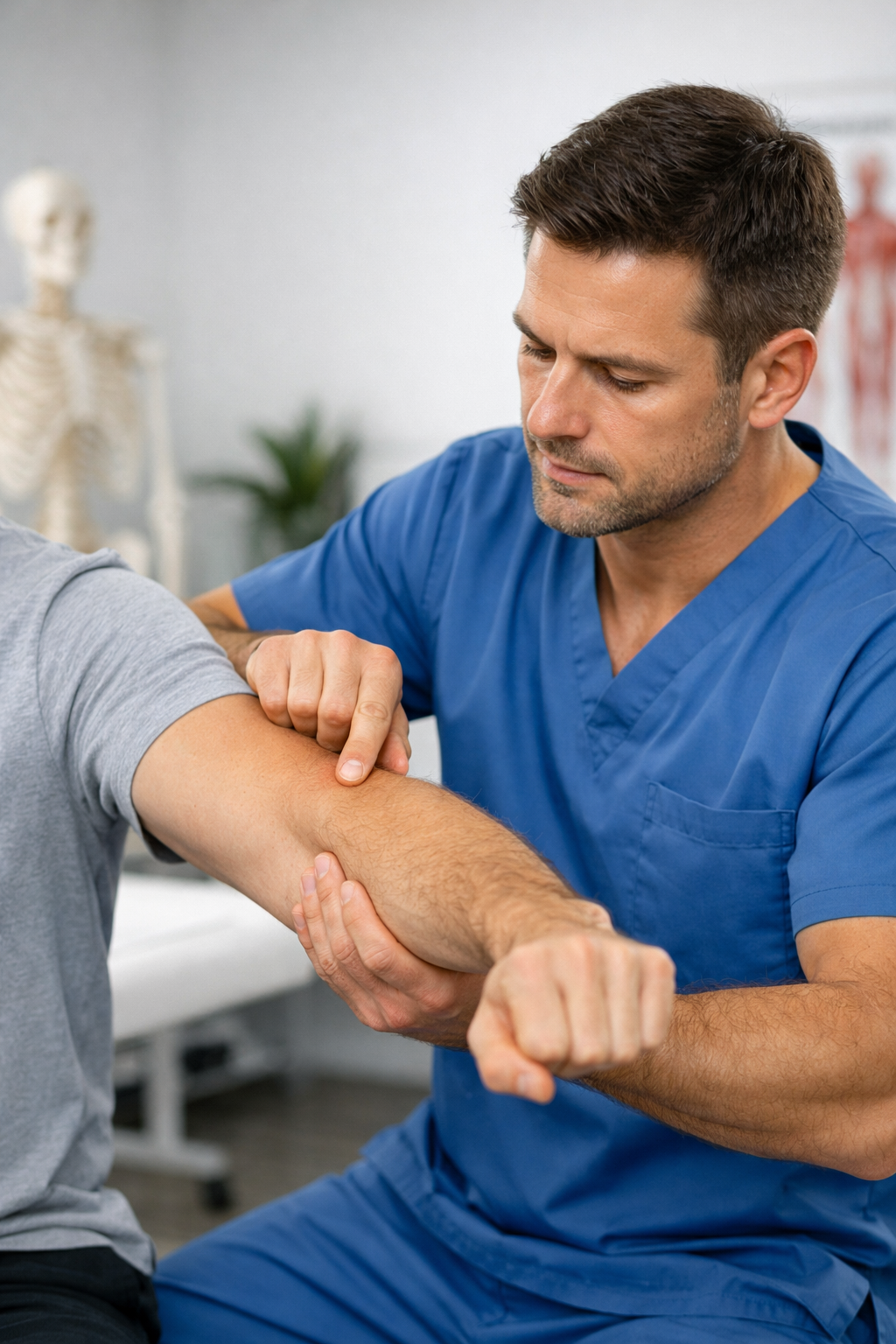
Clifton’s demographics — median age 39-41, diverse working population, 60 percent homeownership, 28-minute average commute to NYC — create a city where occupational overload and weekend recreation collide on the same tendon. Here are three patients Trinity Rehab Clifton sees regularly.
The Route 3 Warehouse Worker
Carlos, 35, works at a UPS distribution facility along Route 3. His shift runs from 4 a.m. to noon: eight hours of scanning, gripping, lifting, and stacking packages. Three months ago, a persistent ache settled on the outside of his elbow. Now he cannot grip a gallon of milk without wincing. Rest and ibuprofen have not helped — the pain returns the moment he is back on the line.
Carlos has classic occupational lateral epicondylitis — cumulative gripping load has degraded his ECRB tendon past its capacity to self-repair. Warehouse and logistics workers along Route 3 and Route 46 are among the most common tennis elbow patients at Trinity Rehab Clifton.
The Albion Park Pickleball Player
Diane, 52, discovered pickleball through Clifton Recreation’s adult open play at Albion Memorial Park two years ago. She now plays three to four times a week, often back-to-back games in the summer heat. She also gardens on weekends near Botany Village. The elbow pain started as a mild pull after long sessions. Within six weeks, it was sharp enough to disrupt her backhand dink and make pruning shears impossible to use.
Diane’s lateral elbow tendinopathy stems from the combination of high pickleball volume and sustained gripping in yard work — a dual-load pattern common in Clifton’s active, homeowning population.
The Clifton Mustangs Tennis Player
Aiden, 16, plays varsity boys tennis at Clifton High School and trains year-round. His serve volume climbed sharply when he moved from JV to varsity. Midseason, a burning sensation appeared on the outside of his hitting elbow. He played through it for three weeks before his grip started failing during matches. His parents brought him to Trinity Rehab after his coach noticed him shaking out his arm between points.
High school athletes at Clifton High School — especially in tennis, baseball, and softball — are vulnerable when volume spikes outpace tendon adaptation. Early physical therapy produces better outcomes and keeps athletes on the court.
Also at Risk in Clifton
- Costco and Home Depot workers with sustained gripping, stocking, and lifting demands
- Healthcare professionals at Hackensack Meridian Health — patient handling and clinical tasks load the lateral elbow relentlessly
- Golfers at Upper Montclair Country Club — controlled grip and forceful wrist action across 27 holes
- Garret Mountain hikers using trekking poles — sustained pole grip on steep terrain strains the forearm muscles
- Homeowners across Clifton — 60 percent ownership means constant yard work, painting, and DIY projects
How Physical Therapy Treats Tennis Elbow at Trinity Rehab Clifton
Your physical therapist builds a phased program around your job, your activities, and the current state of your tendon.
Phase 1: Pain Reduction and Load Management
The first step is to reduce pain without shutting down your life. Your therapist evaluates tendon tolerance and designs activity modifications — adjusting package handling for a warehouse shift, modifying pickleball grip for court play, or reducing serve volume for a high school season.
Manual therapy is central: soft tissue mobilization of the forearm muscles, lateral elbow joint mobilizations, and targeted wrist and shoulder work to reduce inflammation and restore movement. A counterforce strap may be recommended to offload the ECRB during gripping tasks at work or on the court.
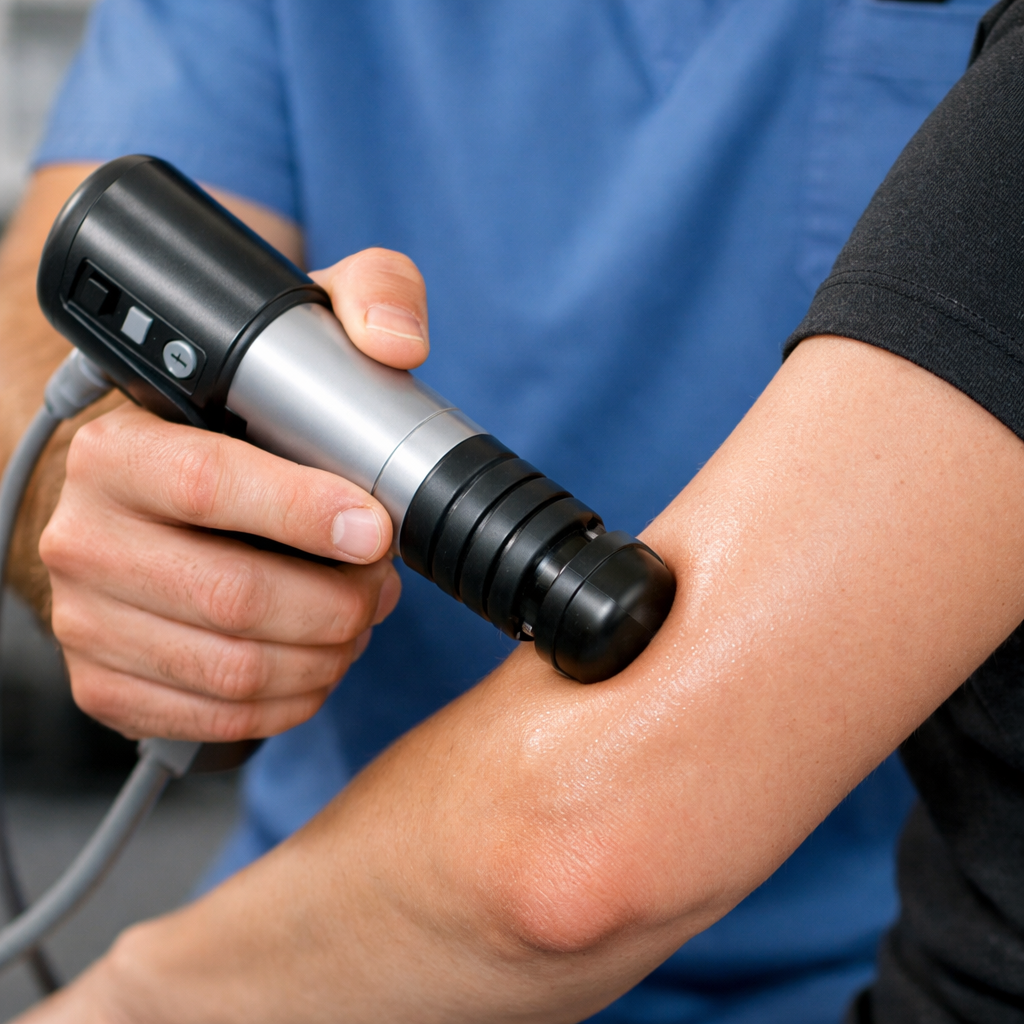
Trinity Rehab Clifton offers EPAT shockwave therapy, a non-invasive treatment delivering acoustic pressure waves to the damaged tendon to stimulate blood flow and cellular repair — meaningful pain relief without the risks of corticosteroid injections or surgery. Dry needling is also available, targeting myofascial trigger points in the forearm muscles to release tension and improve circulation.
Phase 2: Progressive Strengthening
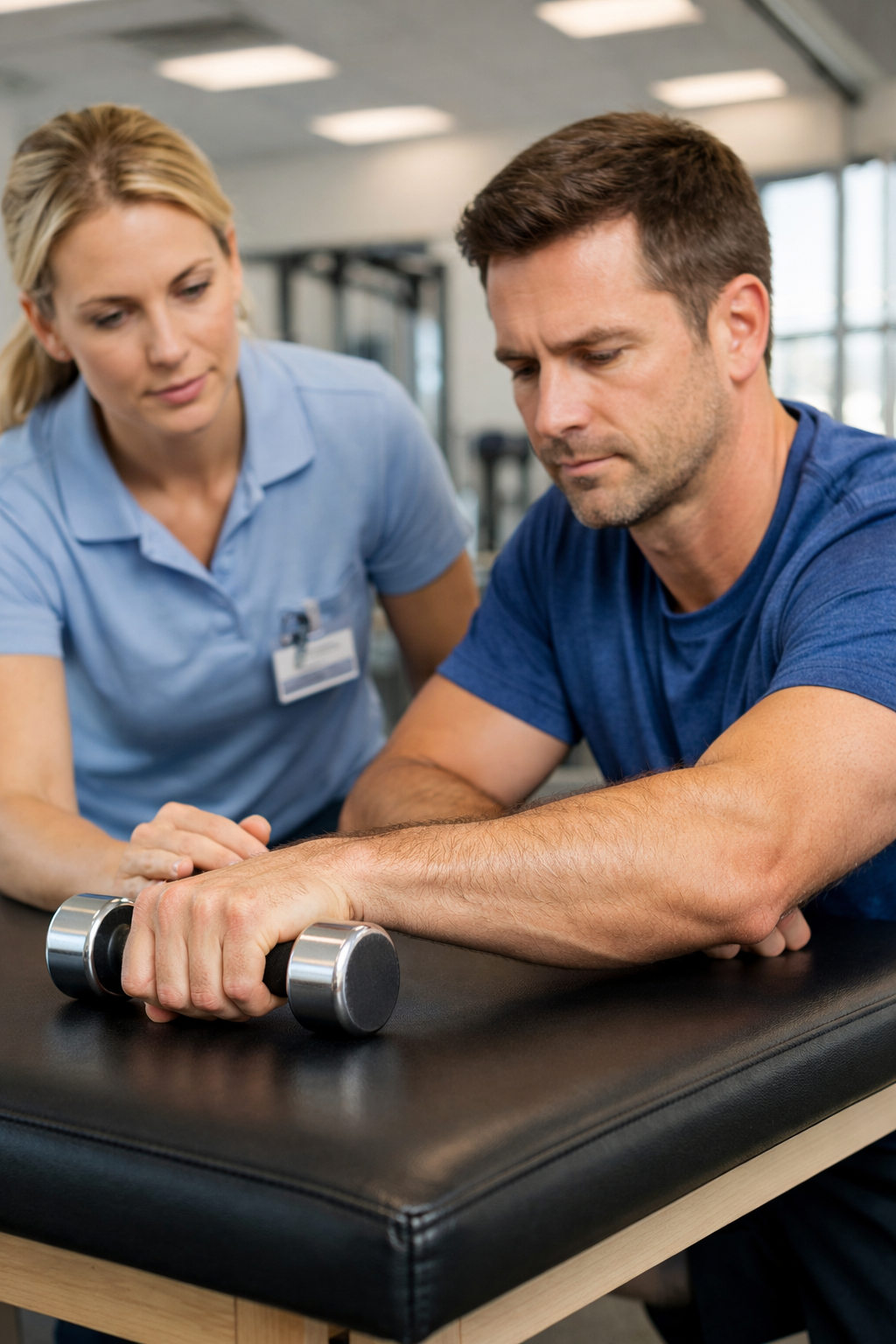
This is where eccentric exercise becomes the foundation. Eccentric loading — slowly lowering a weight as the muscle lengthens — promotes tendon remodeling and builds long-term tendon tolerance. Your therapist guides you through:
- Eccentric wrist extension: Forearm supported, palm facing down from a starting position on a table edge. Slowly lower a light weight. Exercise slowly, in sets of 15.
- Grip strengthening: Progressive grip work using a tennis ball or therapy putty, rebuilding functional strength.
- Forearm pronation and supination: Rotating the forearm with a weighted tool — palm up, then down — restoring rotational strength for gripping and swinging.
- Towel twists: Wringing a rolled towel in both directions, shoulders relaxed, for forearm endurance.
- Wrist extension stretches: Gentle stretching with the arm outward and elbow straight, held 30 seconds.
Minimal equipment needed — a light dumbbell, a towel, and a flat surface cover the home program. Your therapist monitors response and adjusts loading to stay within the tendon’s capacity while progressively expanding it.
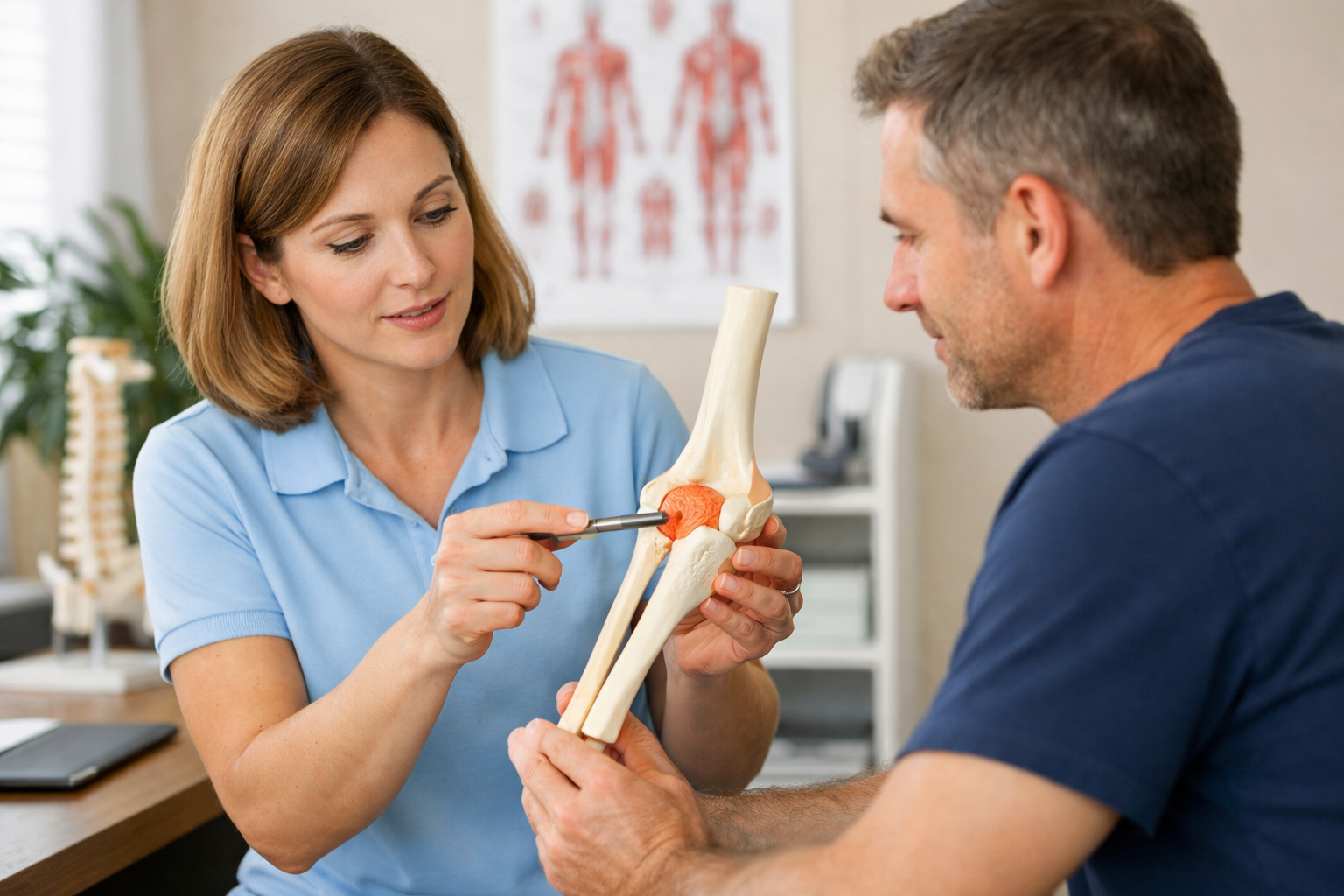
Phase 3: Return to Activity and Sport
Recovery does not stop when the pain subsides. For Diane, return to activity means a structured pickleball progression at Albion Park. For Carlos, workplace pacing strategies and ergonomic grip adjustments. For Aiden, a graduated return-to-serve protocol that respects his long term goals across the season.
Trinity Rehab Clifton’s sports med expertise ensures treatment continues until you can play sports, work, and live at your pre-injury level.
Why Choose Trinity Rehab Clifton?
One-on-one care, every session. You work directly with a licensed physical therapist who knows your history and adjusts your plan in real time. For tennis elbow management — where tendon tolerance shifts week to week — this attention drives real recovery.
Advanced technology. EPAT shockwave therapy, dry needling, and expert manual therapy give your therapist multiple tools to treat tennis elbow from every angle, accelerating pain relief beyond what exercises alone achieve.
Direct Access. New Jersey law lets you start physical therapy without a physician referral. The moment elbow pain interferes with your work or your weekend — call Trinity Rehab and start treatment this week.
Convenient for the region. Easily accessible for Clifton, Passaic, Paterson, Little Falls, and Montclair residents — whether you come from the Route 46 corridor, the Parkway, or neighborhoods near Main Memorial Park.
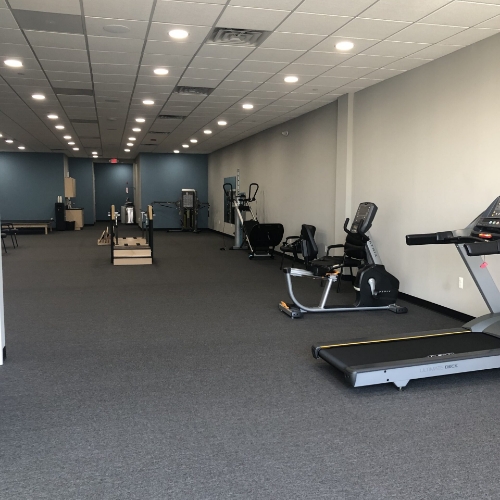
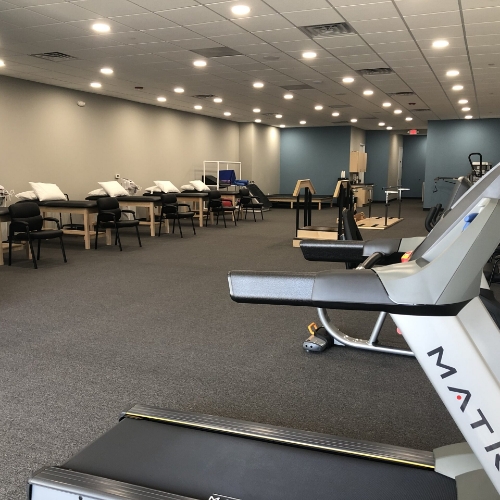
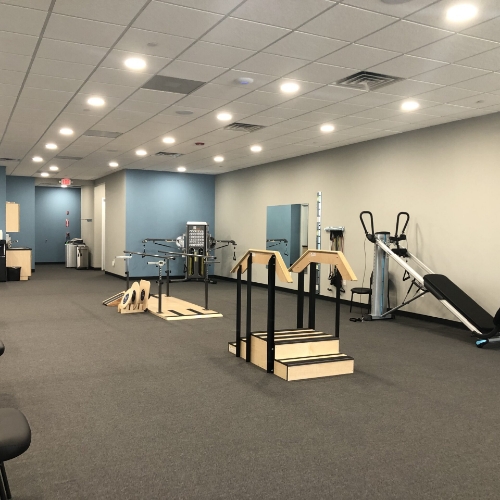
Inside Our Clifton Clinic
Related Conditions & Treatments
Tennis elbow is just one of the many conditions we treat at Trinity Rehab Clifton. Explore our full range of conditions we treat or learn more about specific treatment approaches:
- Tennis Elbow Treatment Overview — Our comprehensive guide to lateral epicondylitis recovery
- Elbow, Wrist & Hand Pain Relief — Other upper extremity conditions we specialize in
- Shoulder Pain Relief — Treatment for rotator cuff, frozen shoulder, and more
- Manual Therapy — Hands-on techniques to restore joint mobility and reduce pain
- Dry Needling — Trigger point therapy for deep muscle tension and pain relief
Related Elbow Care At This Location
Elbow pain can come from different tendon and loading patterns around the joint. A related same-location page is:
Frequently Asked Questions
Can physical therapy fix tennis elbow without surgery?
How long does tennis elbow take to heal?
I work at a warehouse on Route 3 — can I get treated before or after my shift?
Will a counterforce strap help my tennis elbow?
Can I keep playing pickleball at Albion Park during treatment?
Clifton does not slow down, and neither should you. Whether the pain started on the UPS line, at Albion Park’s pickleball courts, on Garret Mountain, or mid-match for the Mustangs — it is treatable, and recovery is predictable with the right program.
Get back to your life — schedule your appointment at Trinity Rehab Clifton today. No referral needed.