
PLANTAR FASCIITIS TREATMENT IN WOODBRIDGE, NJ
Woodbridge Township is New Jersey’s oldest and one of its busiest. It’s a place of genuine hustle — warehouse workers loading cold-storage facilities through night shifts, commuters heading to the Woodbridge Train Station before dawn, Barrons athletes grinding through their seasons, families walking the Sewaren Waterfront Walkway or cutting across Eric LeGrand Park on an afternoon stroll. With that level of daily activity, the feet take a beating.
Plantar fasciitis is one of the most common consequences of the way Woodbridge residents live and work. It’s the sharp, stabbing heel pain that strikes before you’ve even fully stood up, the stiffness that follows you through the morning, and the aching that returns after every long shift or sit-down meeting. It has a way of quietly reorganizing your entire day around avoiding the worst moments.
What it should not do is keep you sidelined indefinitely. With the right physical therapy approach, the vast majority of people with plantar fasciitis recover fully and return to everything they were doing before. Trinity Rehab’s therapists are here to make that happen for Woodbridge patients.
THE ANATOMY OF THE PROBLEM
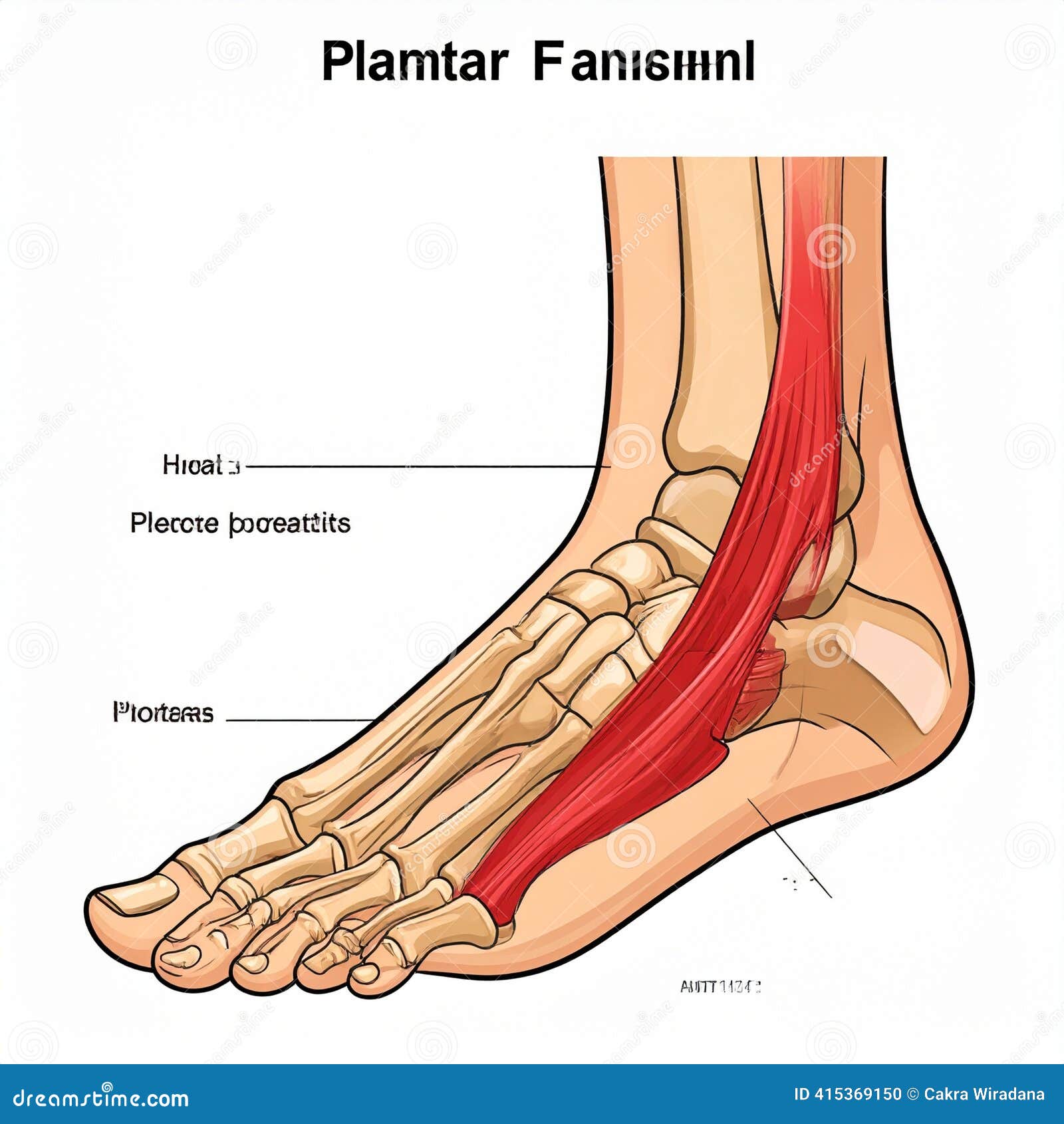
Your plantar fascia is a dense band of fibrous connective tissue — roughly the length of your foot’s sole — that runs from the calcaneus (heel bone) to the metatarsal heads at the ball of your foot. It functions as the primary passive support structure for your arch and acts as a tensile cable that stores and releases energy during walking and running.
Plantar fasciitis occurs when the cumulative mechanical load on this tissue exceeds its capacity to repair between loading cycles. The result: micro-tears accumulate at the fascial attachment to the heel, triggering an inflammatory response. Without a reduction in loading or targeted treatment, the tissue progresses from acute inflammation to chronic degeneration — a state that becomes progressively harder to reverse over time.
The American Academy of Orthopaedic Surgeons estimates that plantar fasciitis affects 2 million people annually in the United States. Adults between 40 and 60 are most commonly affected, though the condition occurs across the age spectrum — particularly in people with occupational or athletic loading patterns that tax the tissue repeatedly. Physical therapy is the most effective first-line treatment and resolves the majority of cases when applied correctly.
RELATED CONDITIONS & TREATMENTS
Plantar fasciitis is just one of the many conditions we treat at Trinity Rehab Woodbridge. Explore our full range of conditions we treat or learn more about specific treatment approaches:
HOW WOODBRIDGE LIFE STRESSES THE PLANTAR FASCIA
Several factors common to Woodbridge Township life create particular vulnerability to plantar fasciitis.
Logistics and warehouse workers represent a large share of Woodbridge’s workforce. Lineage cold storage, R.A.S. Logistics, Freezpak Logistics, and the numerous warehousing and distribution operations throughout the Route 9 corridor employ thousands of residents in jobs that demand prolonged standing and repetitive walking on unforgiving concrete floors. The NJ Turnpike Authority headquarters and Wakefern’s ShopRite distribution operations add office and operational workers who spend significant time on hard surfaces as well. Cold environments like refrigerated warehouses may compound the problem — cold reduces tissue extensibility and increases the risk of fascial strain.
Retail workers at Woodbridge Center mall and surrounding retail corridors experience similar prolonged standing patterns on hard floors, often in footwear chosen more for appearance than biomechanical support.
Commuters who use Woodbridge’s extensive transit infrastructure — the train station, bus lines, and park-and-ride connections to the Turnpike and Parkway — do significant amounts of walking on hard, uneven urban surfaces. That combination of pavement, station platforms, and commuter rush acceleration and deceleration adds up over a week’s worth of commutes.
Woodbridge High School Barrons athletes across track and field, cross-country, football, and soccer carry the overuse injury risks inherent to competitive high school athletics. Runners who increase volume heading into championship season and football players whose preseason conditioning involves high-intensity volume both accumulate the fascial loading that predisposes toward plantar fasciitis.
Waterfront and trail walkers who use the Sewaren Waterfront Walkway (1.5 miles along the Arthur Kill), Eric LeGrand Park, Pin Oak Forest trails, and the wider Woodbridge park system encounter surfaces ranging from packed gravel to paved walkways — all capable of producing the repetitive impact that stresses the fascia, particularly in unsupportive footwear.
SYMPTOM RECOGNITION
Plantar fasciitis announces itself in a characteristic way that experienced clinicians recognize immediately — but it’s still worth getting a proper assessment to confirm the diagnosis and rule out other causes.
The hallmark is severe heel pain with the first footfall of the morning. During sleep, the plantar fascia shortens and contracts. The body weight of the first step creates a sudden, intense stretch at the calcaneal attachment that many patients describe as stepping on a nail, hot coal, or sharp stone. After 10 to 20 minutes of walking, the tissue warms and becomes less reactive — pain decreases, sometimes dramatically. This morning pattern, and the return of pain after any period of rest, is the most diagnostically specific feature of plantar fasciitis.
You may also notice:
- Heel soreness that surfaces after a long warehouse or retail shift — worse toward the end of the day
- Pain that flares up after sitting at a desk or in a car, with the first steps being the most uncomfortable
- Point tenderness directly under the heel, most pronounced on the inner (medial) side
- A tight, rope-like feeling along the arch that persists even when the sharp heel pain has eased
- A subtle but progressive change in your gait — shorter stride, slight limp, or rolling to the outside of the foot
A Woodbridge resident who works at a distribution center described the trajectory clearly: “I started noticing it after long shifts. Then it started happening in the morning, then during my commute. I was limping to the train. I didn’t realize how much I was adjusting my whole walking pattern until my knee started bothering me too.” That downstream knee pain is a classic warning sign that altered gait from untreated plantar fasciitis is beginning to create secondary complications.
PHYSICAL THERAPY: PHASE-BY-PHASE RECOVERY
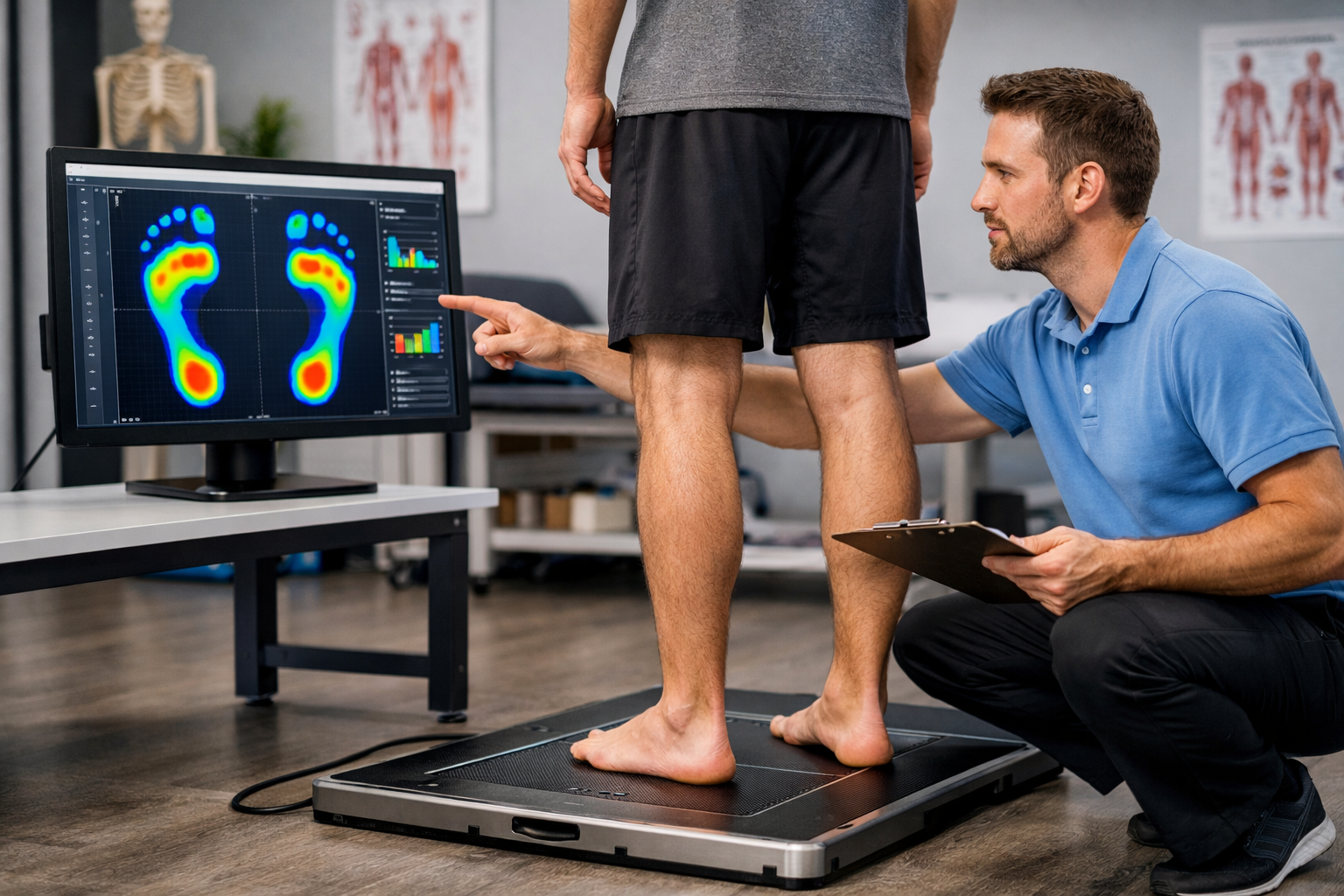
Trinity Rehab designs every plantar fasciitis treatment plan based on a comprehensive evaluation of your specific presentation — foot mechanics, ankle mobility, gait analysis, and the occupational and recreational demands your foot faces.
PHASE 1: PAIN REDUCTION AND TISSUE CALMING
The initial phase focuses on interrupting the pain cycle and reducing the fascial irritation that is preventing healing.
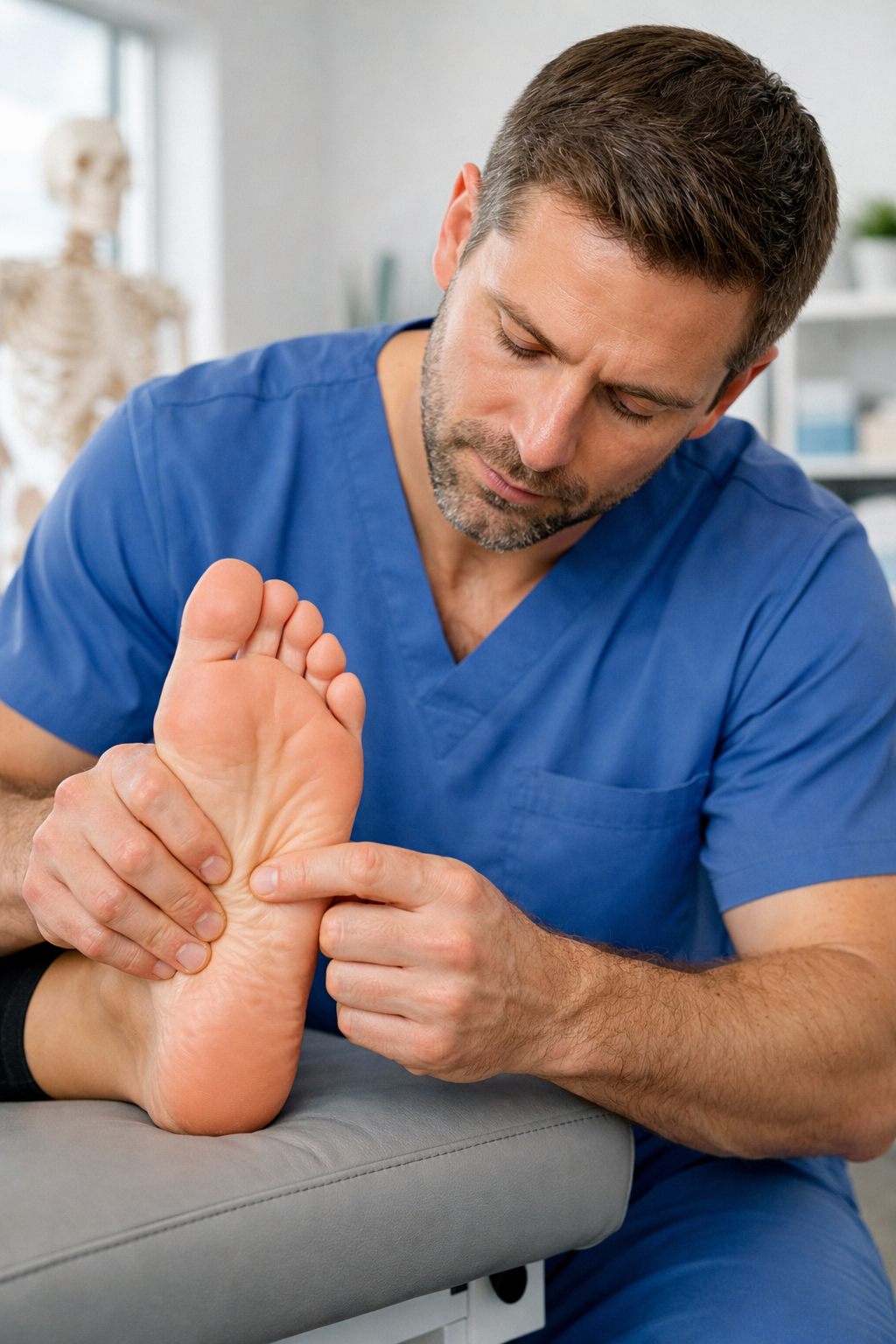
Manual therapy is central from the very first session. Ankle and subtalar joint mobilization restores restricted dorsiflexion range of motion — one of the most consistently identified mechanical drivers of plantar fasciitis. When the ankle can’t complete its full arc of motion, every step compensates by placing excessive strain on the plantar fascia. Research published in the Journal of Orthopaedic & Sports Physical Therapy demonstrates that joint mobilization produces significantly better outcomes than isolated stretching alone.
Instrument-assisted soft tissue mobilization (IASTM) breaks down fascial adhesions, and myofascial release targets the trigger points in the gastrocnemius, soleus, and foot intrinsic muscles that maintain constant background tension in the fascia.
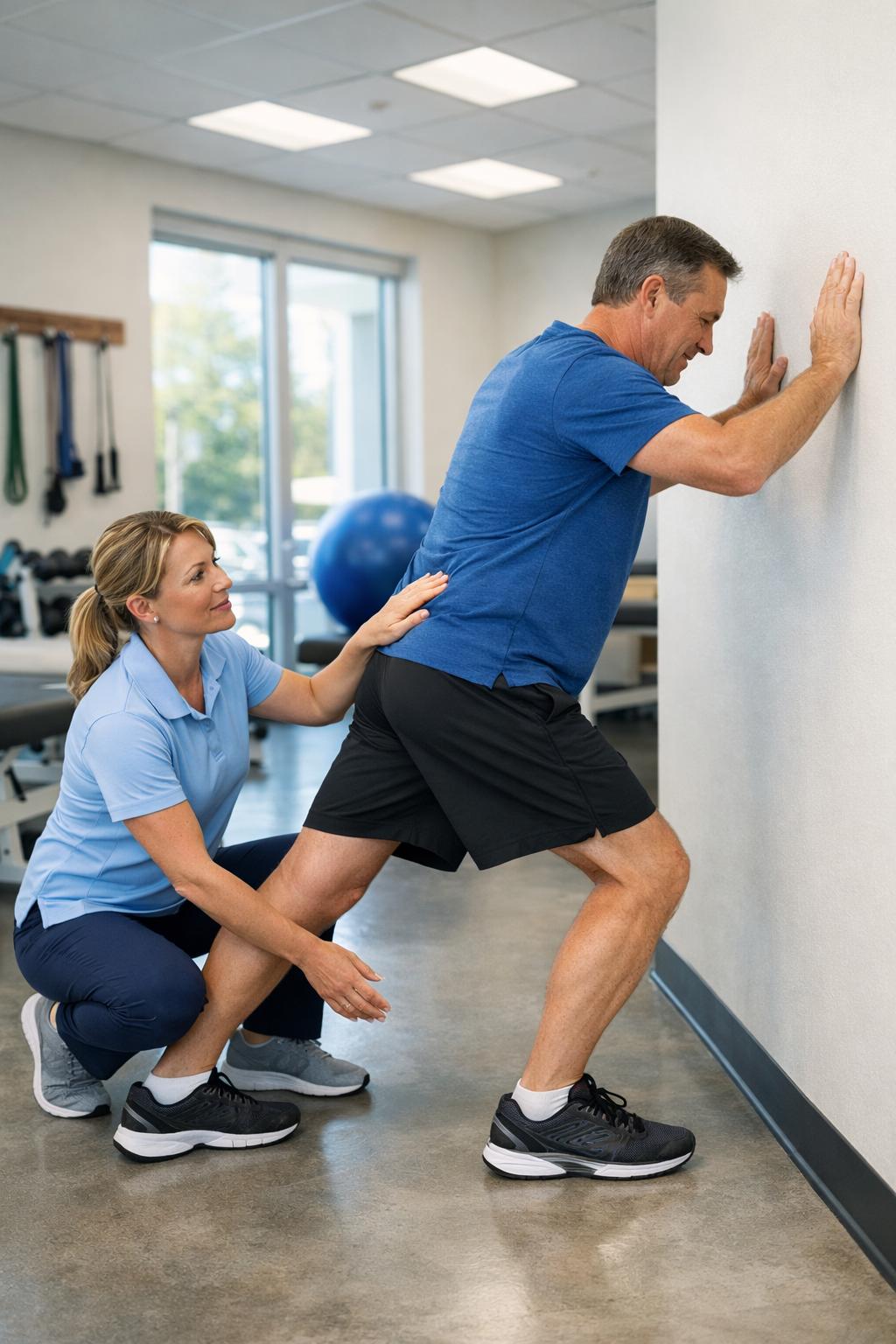
Stretching begins immediately. The plantar fascia-specific stretch (toes-back dorsiflexion before the first step of the morning) and individualized calf stretching targeting the tight structures driving dorsiflexion restriction form the core of the early home program.
Therapeutic ultrasound may be applied to promote circulation and cellular repair in the damaged tissue. Kinesiology taping provides fascial offloading between sessions during periods of high activity.
PHASE 2: RESTORING STRENGTH AND BIOMECHANICAL FUNCTION
Once pain is manageable and tissue irritability is reduced, the treatment shifts toward rebuilding the structural capacity that was compromised before or because of your plantar fasciitis.
Eccentric calf raises are the gold standard for progressive fascial loading — slowly lowering the heel over the edge of a step builds the tensile strength and collagen density that allow the fascia to handle load without breaking down. Intrinsic foot strengthening (towel scrunches, marble pickups, short-foot exercises) develops the internal arch support system. Proprioceptive training on progressively unstable surfaces restores the neuromuscular function that typically degrades when pain has altered gait patterns.
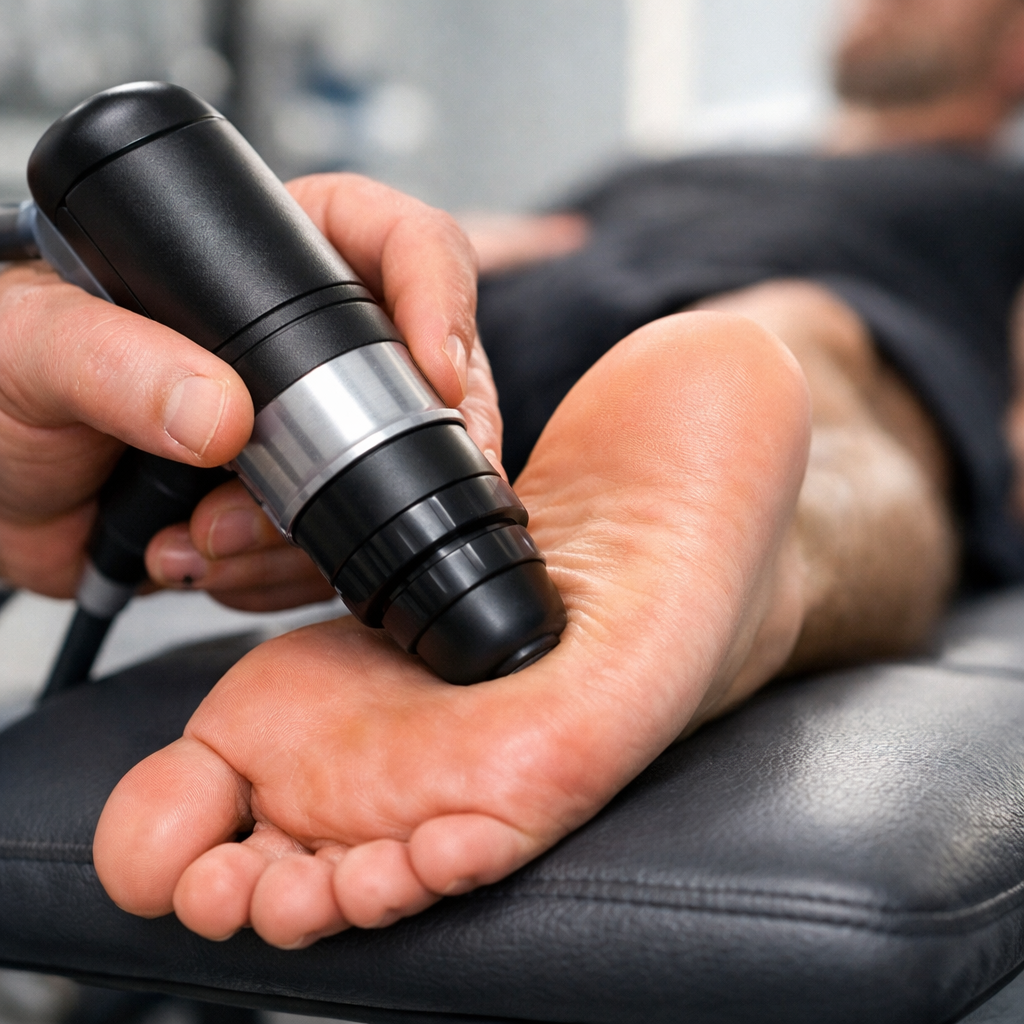
For patients with persistent or treatment-resistant plantar fasciitis, Trinity Rehab offers EPAT shockwave therapy — acoustic pressure waves that penetrate the damaged tissue, stimulate blood flow, and activate cellular regeneration. The Mayo Clinic identifies EPAT as effective for chronic cases. Dry needling addresses myofascial trigger points in the calf complex that maintain fascial tension even between loading events.
PHASE 3: RETURN TO FULL ACTIVITY
The final phase bridges clinical progress to the real-world demands of your life. For warehouse workers, this includes systematic progression of standing tolerance and load-carrying capacity. For Barrons athletes, it’s a structured return-to-sport protocol built on the foundation of the strength work done in Phase 2. For commuters, it’s making sure that the daily walking demands of your commute can be met without re-loading the fascia faster than it can recover.
Footwear assessment is a critical component — your therapist will evaluate what you’re currently wearing at work and during activity and make evidence-based recommendations. Custom orthotics or high-quality inserts may be prescribed for patients with structural biomechanical issues.
PREVENTION FOR THE WOODBRIDGE LIFESTYLE
- Occupational footwear is non-negotiable. If you work a warehouse or retail job in Woodbridge, invest in footwear with a thick, supportive midsole, genuine arch support, and a slight heel elevation. This is not an area where low-cost athletic shoes suffice.
- Use anti-fatigue matting where possible. Warehouse and kitchen environments that permit matting dramatically reduce the cumulative fascial load of prolonged standing — ask your employer if mats are available at your station.
- Walk the Sewaren Waterfront Walkway in supportive footwear. The 1.5-mile walkway is a beautiful community resource, but flat sandals and flip-flops on hard paved surfaces create significant fascial load. Choose a walking shoe or supportive sandal.
- Replace commuter shoes regularly. The shoes you wear on your commute to the Woodbridge Station and through city streets accumulate midsole compression faster than most people expect. Replace them based on use, not appearance.
- Stretch after every long shift. A two-minute plantar fascia stretch and calf stretch at the end of a warehouse or retail shift is a highly effective preventive investment.
WHY WOODBRIDGE PATIENTS CHOOSE TRINITY REHAB
At Trinity Rehab, one-on-one care is not a marketing phrase — it’s the operational model. Your licensed physical therapist conducts your evaluation, designs your treatment plan, and delivers your hands-on care at every session. This level of continuity is particularly important in plantar fasciitis treatment, where the pacing of loading progression significantly affects outcomes.
We work with most major insurance plans, require no referral, and understand the scheduling realities of warehouse shift workers, commuters, and busy Woodbridge families. Our therapists are experienced with the full range of foot and ankle conditions, and we treat the whole patient — including the back pain and sciatica that so commonly develop when untreated plantar fasciitis alters your gait for months at a time.
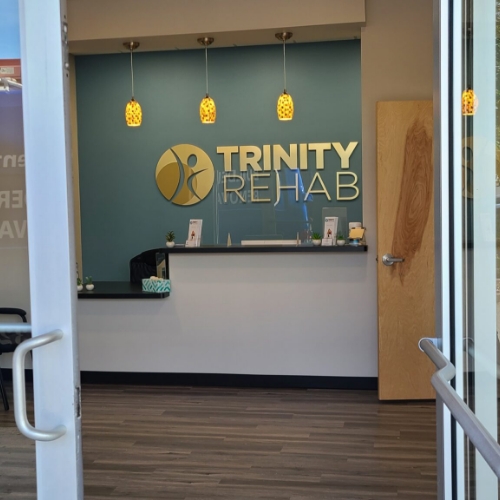
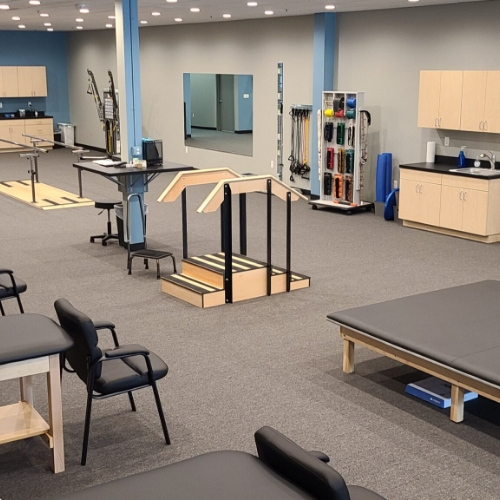
Inside Our Woodbridge Clinic
FREQUENTLY ASKED QUESTIONS
Where can I get plantar fasciitis treatment in Woodbridge, NJ?
I work overnight warehouse shifts. Can Trinity Rehab accommodate my schedule?
How long does plantar fasciitis take to resolve?
Can my knee pain be caused by my plantar fasciitis?
What’s the difference between plantar fasciitis and Achilles tendinitis?
START YOUR RECOVERY
Woodbridge doesn’t slow down, and neither should you — not because of heel pain. Whether you’re back on the floor at the distribution center, walking the Sewaren Waterfront at sunrise, or getting back on the Barrons sideline, Trinity Rehab is here to help you return to full activity without compromise.
Request your appointment today — no referral required, most insurance accepted.
Sources: JOSPT Clinical Practice Guidelines for Heel Pain/Plantar Fasciitis, 2023 | Mayo Clinic — Plantar Fasciitis | American Academy of Orthopaedic Surgeons | APTA Clinical Practice Guidelines
What Our Patients Say